Editors’ Note: An earlier version of this paper was delivered under the title “Lewis and the Revolution” as part of a panel entitled “Lewis and the World” at the Ciceronian Society Annual Conference at Creighton University, March 12-14, 2026.
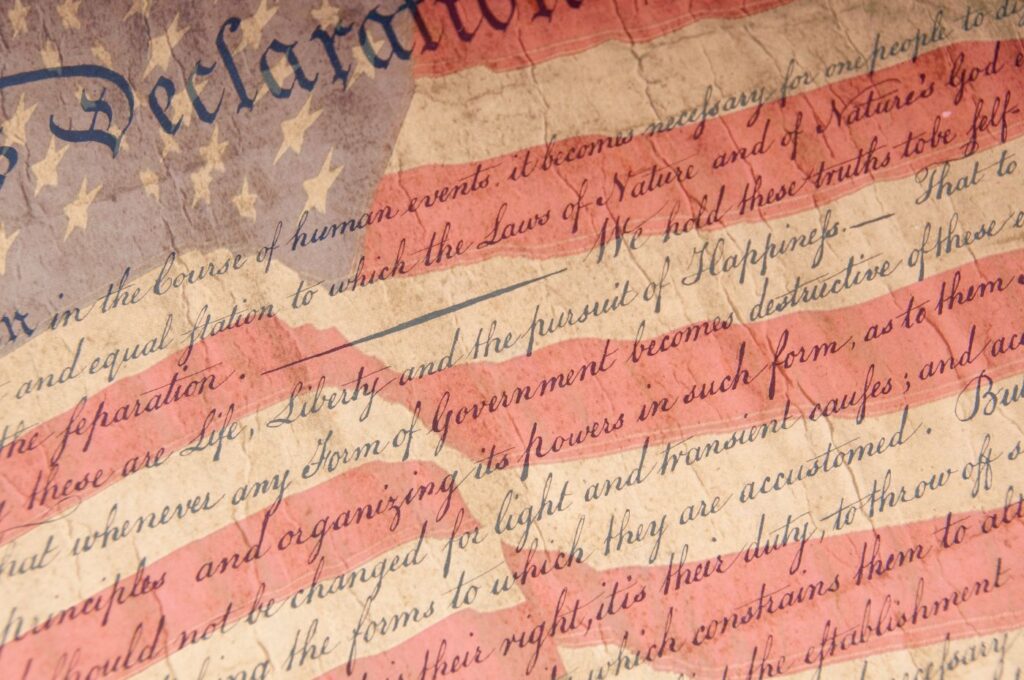
On a less auspicious anniversary year than our 250th, an unlikely apologist nonetheless weighed in on the Declaration of Independence and, more specifically, the third in the trio of inalienable rights: the pursuit of happiness. The unlikely apologist was C. S. Lewis. He was, according to Walter Hooper, asked by The Saturday Evening Post editor Thomas Congdon to write “an essay … debunking the modern notion that we have a ‘right to happiness.’” Lewis ultimately agreed, and wrote a provocative response entitled “We Have No ‘Right to Happiness’.””
Lewis and Politics
Generally, Lewis avoided talking about politics. But he did live through a kind of revolution in his own lifetime in his homeland, with the division of Ireland taking place a year before Lewis’s graduation with his Classics degree. This subject, and the subsequent ongoing sectarian conflict, are sometimes mentioned in Lewis’s correspondence, particularly with friends and relations still in Ireland, and with close attention paid to Ulster, given its particular circumstances in the partition. For instance, in a letter to his father in August 1924, he mentions the situation in Ireland alongside the contemporary revolutions triggered by the removal or abdication of monarchs in Russia (1917) and Germany (1918) and writes with some trepidation “that the situation [in Ulster] is as serious now as ever it has been since the trouble started.”
However, ordinarily when Lewis did mention politics, it was often with disinterest, confusion, or despair. In “Equality,” twenty years before his “No ‘Right to Happiness’” piece, Lewis declared himself a democrat. Lewis clarifies that he is “a democrat because [he] believe[s] in the Fall of Man” and thus there is an inherent need for democracy. In “Equality” Lewis concludes: “Mankind is so fallen that no man can be trusted with unchecked power over his fellows.” The committee that drafted the Declaration of Independence also recognized, and spoke out about the danger of unchecked power, especially its consequences for those who are powerless to act themselves. In another case of Lewis’s engaging with politics, in a letter written just over a week before he died, Lewis bemoans how the newspapers “are filled with nothing but politics, a subject in which I cannot take any great interest,” and then goes on to relate his brother’s prediction of a Labour government “with all the regimentation, austerity, and meddling which they so enjoy.”
Start your day with Public Discourse
Sign up and get our daily essays sent straight to your inbox.Lewis also occasionally discussed contemporary American politics in his letters. This is hardly surprising given the volume of American correspondents he swiftly acquired after the success of The Screwtape Letters. The most notable and amusing discussion of American politics by Lewis is in a letter to Vera Gebbert, where he inquires:
[D]oes anyone in America understand American politics? Certainly no one over here can make out what is happening, in spite of numerous inspired articles by so called experts; [or] people who pretend to know all about it—on the strength of a lecturing tour in the States … I thought I was going to learn something from an old lady in Connecticut the other day, but at the end of eight pages so hot that they nearly burnt my fingers, all I could gather was that the “Dumbocrats” as she called them, are a sort of mixture of Hitler, the Russian secret police, and the inmates of the village lunatic asylum: but no doubt this view is a little prejudiced.
One can practically see the glint in his eye as he blends hyperbole and deadpan delivery. But we also see that Lewis recognized how heated the political situation was in America, particularly during the Cold War.
Speaking Out
Lewis’s piece on the Declaration was first published as the opening article in an issue for the Christmas season. In addition to the “teaser” line on the cover—“HAPPINESS is it a right?”—there was also a brief blurb to accompany this “Speaking Out” column … It read: “Is happiness—in particular, sexual happiness—one of man’s inalienable rights? A distinguished author attacks the brutality of this increasingly common notion.” In subsequent reprintings, this strapline is lost, presumably because it was not written by Lewis. However, this framing does affect how we read the essay. The slant the editorial gloss draws out—that such normalizing of this desire as an “inalienable right” is indicative of the degradation of a society that does not recognize the “brutality” of such a position—is particularly useful.
This extra paratext, subsequently hidden in its reprints, speaks especially to the Public Discourse pillars of politics and law, and sexuality and family. In this essay, Lewis directly addresses our tendency to want to use emotional reasons to justify immoral behaviors, to say that this right directly correlates with the feelings of those individuals. And that, by implication, to deny this would be to deny their happiness. The moral “right,” not the legal “right,” is what is meant in this case, and Lewis indicates the dangers of such a way of thinking that equates the two.
Lewis on the Declaration
Lewis makes clear when he is asked to address this subject that he certainly could not do so “without discussing a formula that is rather sacred to Americans about the ‘right to life, liberty and the pursuit of happiness.’” He promises to “do so with respect” but also with firmness and a clear position that the right to the pursuit of happiness “can only mean ‘the right to pursue happiness by legitimate means’, i.e. ‘people have a right to do only whatever they have a right to do.’” This shows not only his familiarity with the Declaration, but also the fact that he has thought about what the right to pursue happiness might mean in practical terms, and what it means to consider the real hope of the American dream as enshrined in the moral underpinning of the right to the pursuit of happiness. He has also considered what it might continue to mean in the sixties in a more “progressive” world where the right to happiness is equated with happiness of a particular kind.
Lewis recognizes the risk it would be for him to challenge (or be seen to be challenging) a key line of the Declaration, by the very argument the editor asks him to put forward. But he also indicates his respect for this key tenet of “that august Declaration” and the rights enshrined therein. In the published response, he is even more emphatic in his praise for the Declaration and in particular the “inalienable Rights” set forth “in words that are cherished by all civilized men, but especially by Americans.” He also clarifies what he takes Jefferson to mean: that the natural law underpins the right to the pursuit of happiness. Thus, the desire to pursue happiness ought to be complementary to, not at odds with, other individuals and their pursuit of happiness.
Lewis challenges the liberality of everyone having a “right” to happiness when he notes that the founding fathers meant the right to pursue happiness within certain legal limitations. It did not mean this right extended to unlawful pursuits of happiness, or pursuits that go against the “Laws of Nature and Nature’s God.” He places the Declaration in its historical context to help clarify why this right to pursue happiness for all is a radical demand and yet a vital inalienable right. The radical nature in the Declaration’s stance becomes especially clear when it is contrasted with the European approach to governance in their own nations and especially their colonies, as Lewis notes: “the declaration is primarily a denial of the political principles which long governed Europe,” including the primary addressee of the Declaration: “England before the Reform Bills.” But while individuals might wish to modify the means by which happiness might be pursued, in order to have greater freedom, Lewis argues the “question as to what means” of the pursuit of happiness “are ‘lawful’ … remains exactly where it did” in 1776.
Previously Lewis himself had directly addressed the role of the nation (or state) in the happiness of a member of that nation (or state) in Mere Christianity. There he declared that the purpose of the state’s existence was “simply to promote and to protect the ordinary happiness of human beings in this life.” This sounds rather like human beings having a right to at least “ordinary happiness.” But this is not the same as the right to personal happiness at any cost. The examples Lewis lists indicate that this is “ordinary happiness” for all. Lewis contrasts the church and state, especially stressing the state’s participation in assuring our happiness in the here and now but, by implication, not in the eternal. Although Lewis does not address this here, the Declaration fundamentally links our potential happiness as citizens of a just state to the Creator God who has endowed us with such rights.
In Mere Christianity, Lewis is talking about protecting ordinary normal life, work, marriage, and family life – what we might call mundane happiness. He is calling us back, in fact, to happiness as Jefferson conceived of it: both public and private happiness. And the state’s role, Lewis argues, is to work toward assuring the ordinary happiness of its members to live lives in peace, not to have their lives interrupted by fights against an unjust state. This might look like a state supporting the people of another state toward liberty, peace, and ordinary happiness when a despotic ruler is denying them these rights (as was the case for many in WWII Britain at the time Lewis spoke these words).
In the terms of the Declaration, the selfish pursuit of happiness is not happiness at all. As Lewis emphasizes, trampling others in order to pursue one’s own happiness contravenes a document that does not grant one man more right to happiness than another. The Declaration “demands that whatever means of pursuing happiness are lawful for any should be lawful for all,” and these are laws sanctioned by the nation. But Lewis also demonstrates that what was intended by such a hope or desire also means pursuing happiness “by all means which the Law of Nature eternally sanctions.”
For Lewis in 1963, the Declaration and its “inalienable” right to the “pursuit of happiness” for all men was at least as countercultural then as when it was first written. Lewis urges his readers to again feel the incredible weight of it, not to be disillusioned or to complain that the American dream is dead, or is only now for some, or that the pursuit of happiness means nothing. Lewis felt deeply the demand for the right to the pursuit of happiness for all men because he was writing “in a century when this is being unsaid by nation after nation.” Sixty-three years later, the skepticism remains, as must Lewis’s sense of urgency.