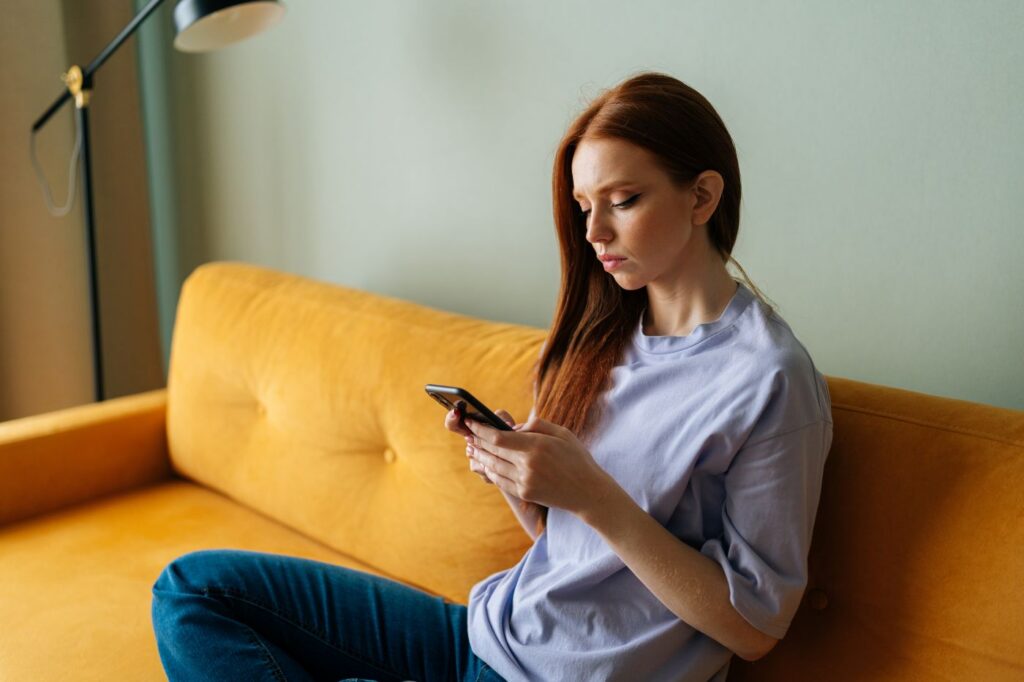
Studies suggest that almost half of American young adults ages 18–29 have used a dating app. When millennials are included in this cohort, the slightly smaller percentage still encompasses more than a third of the population. In other words, well over half of currently unmarried people know how dating apps work, which ones to pick when looking for lasting love (versus hookups), and above all, how rarely their use has made them happier. Hand in hand with the familiarity of dating apps goes the host of issues and dissatisfaction that they cause. A question worth asking, then, is whether abandoning the apps would solve our dating problems. Would in-person encounters make dating easier and lead to successful relationships more often?
Sadly, my answer is no. Our dating problem has much deeper roots, resting on an impoverished understanding of the person and of human relationships and on a mistaken conception of our freedom in choosing love. This is what single people bring to the table today—even when they meet in real life.
My recent interviews with local unmarried young adults in Austin, Texas, confirmed both findings: widespread use of the apps, on one hand, and profound and well-grounded criticism of the new medium, on the other. Besides their low success rate—our interviewees were all single people, after all—both men and women expressed serious concerns about how the apps objectify their users. “Swiping” potential partners as one does with Amazon products, they thought, is not a great way to approach a human relationship. “I don’t think it’s a healthy tool to present so many options. On top of that, it sort of dehumanizes people,” a young man said, echoed by a twenty-four-year-old woman: “I think that they’re increasingly bad for your mental health.” Both sexes were aware, moreover, of how the illusion of infinite choice may be messing with their minds, impairing their willingness or ability to commit—something psychologists have pointed out over the years. “We feel like there are so many options, but there is no one in reality. You speak to so many people online, but none of it really materializes. And there’s so much distrust,” a young woman told us. “I don’t like it. I don’t like how it just creates this perception that there are so many options.” In the words of a thirty-year-old bachelor determined to settle down, “I think [online dating] probably makes me feel more needy, like you need validation, because it feels like you’ve been rejected so many times.”
Men, indeed, report systemic problems too. Several interviewees mentioned the dating apps’ sex biases, pointing to how they favor women. To some extent, they’re right. Across all platforms, the percentage of males tends to be higher than that of females, thus skewing the game from the start. Furthermore, while men cast their nets widely, liking a wide range of women, the gentler sex is much pickier. As a result, only a minority of men (10 to 15 percent) receive most of the women’s replies or direct approaches, leaving all others not only unmatched, but also susceptible to despair. Failure in the dating app world usually leads to lower levels of confidence, decreasing self-esteem, and sometimes even depression.
To say that these mechanisms favor females, however, is quite deceiving. While inundated by likes and first approaches, these overstimulated women are seldom liked for who they truly are: men click on attractive pictures, not on interesting bios or shared values. Vulgarity comes next, with explicit messages (or images) being much more easily shared over online platforms than in public. Women’s safety is also in question, with the risk of running into fake profiles and of sharing private information with scammers determined to take advantage of these women’s weaknesses and romantic dreams. Some commentators suggest that, ultimately, it is the same small percentage of women who will end up pairing with someone compatible. If that is true—as my anecdotal single friends’ evidence overwhelmingly suggests—the majority of the population will simply have wasted a lot of time trying to get there.
Start your day with Public Discourse
Sign up and get our daily essays sent straight to your inbox.The Dating App Trap
To make matters worse, a recent analysis revealed that the underlying reasons to be online are often different from those declared. People genuinely looking for a stable relationship may still end up scrolling profiles merely to escape boredom or to boost their confidence. One of our interviewees admitted doing so: “I got the attention I wanted, and it made me feel like a little less alone or like more wanted.” Across all apps, this phenomenon affects both men and women, inevitably contributing to the users’ frustration, confusion, and dissatisfaction. “They are awful,” a young man told us. Another commented, “It is a trap.”
According to recent statistics, “trap” may be the right term. The success rate of dating apps, measured by the percentage of initial dates that turn into relationships, is currently reported to be around 12 percent. The amount of time and effort to get there is quite significant (70–100 matches before even getting to a date). What “success” means, moreover, remains unclear too. Is it a month, a year, or a lifetime? And will it be marriage, cohabitation, or an open relationship? Nobody knows; dating apps are not old enough for there to be sufficient data. A somewhat popular belief is that people who meet online divorce less, but this kind of broad statement is hard to verify. “The evidence is too inconsistent,” Claude, the AI tool, tells us. According to a British study, especially in the first three years of marriage, couples who met through apps seem to show higher rates of divorce. While this was an isolated report, the explanation seems quite reasonable: people who meet online rather than through mutual friends or family, or environmental connections, are relative strangers to each other. A few years may be just what they need to discover they were not a match.
At that point, some may stick together still: because they found their longed-for soulmate or, brutally, because they dread the idea of experiencing the 100-matches-saga again. If they do go through the process again, dating app users know things about themselves that our grandparents never even considered (try asking your grandmother about her “dealbreakers”). Yet, they married young and stayed married. We don’t. Based on our interview data, the number of people who repeat the cycle is significant: several reported relationships that started off on the apps, lasting longer than a few weeks or months. Except for one engaged man and a woman postponing-but-considering engagement, these app-based encounters all ended.
Unsurprisingly, then, nobody likes dating apps. The allegedly “favored” women say that they mostly increased their likelihood of engaging in casual sex, not of finding love. “People match you based on your facial features or like a couple of sentences you wrote,” one told us. A graduate student said: “Most of the time it ends up being an invite to someone’s place, ending up in sexual intercourse.” A same-sex attracted woman, who finds it helpful to select other lesbian women via the app’s filters, similarly commented: “Many of my experiences on the dating app have not progressed into romantic relationships.”
Are We “Choosing” to Love?
One of the women quoted above made a very reasonable claim: “In the end we all want the same thing, which is love and [to] feel like we … [belong] somewhere.” I think this is true. No matter how great the current enmity between the sexes, this is what my friends and acquaintances all want. But if this is the case, if both men and women still ultimately want to love and be loved and to belong to someone, why do we keep using a system that does not work? And, as suggested above, could it be that the system really isn’t the problem?
In more conservative circles, some are convinced that the apps are the problem, and so they increasingly attempt meeting other singles organically through church groups, book clubs, and other community events. But the results, even of these, are underwhelming. We may still lack data on this, but we do have local evidence. In the Catholic Diocese of Austin, for example, the number of young adults looking for a spouse is significant. Yet, even within that Catholic cohort, which organizes weekly meetups, marriages are very, very few.
Technology, I argue, is not our problem. Undoubtedly, dating apps haven’t helped; they are exacerbating existing problems. Human beings created these apps and shaped them according to their preexisting ideals and preferences. This is what we need to address before we worry about algorithms. Our habit of treating others like products that we use or dispose of according to our own needs and whims does not disappear when we abandon the online world, nor does our unwillingness to commit. If anything, dating apps have brought to light our impoverished understanding of personhood, relationships, and what “choosing” a partner truly means and requires.
In this last regard, whether consciously or not, many believe that we need ample options in order to choose freely. The larger the pool of contenders, the greater our chances of finding love—or so we think. So we download apps with millions of users; in person, we look beyond our towns and social circles, always aiming at something bigger to increase our likelihood of finding our spouse (small towns’ higher marriage rates, in the meantime, prove our theory wrong from the start). But human beings are not objects meant to be compared and evaluated relative to one another, not collections of attributes that we approve or disapprove. Of course, one’s values, politics, and interests say a lot about him, and they matter when it comes to matching. Too often, however, we stop there, with those labels and traits. Rarely, if ever, do we ask “why”: why they think as they do, vote as they do, dress as they do. It is these answers, not the first ones, that will make us want to share our life with a specific other. Those reasons and accounts are the personal answers that no AI companion could ever generate. Relationships unfold over time and in the course of shared experiences, not after a cursory evaluation of traits.
In today’s dating landscape, shared experiences are no longer a critical component of assessing compatibility; we want to find our match quickly, efficiently, decisively. People, however, are not static—nor are our relationships with them. They are complex and to be fully understood over the course of a lifetime.
A few years ago, David Brooks described all these dynamics under the telling chapter title “How not to see a person.” In his words, our inability to truly “ask questions,” generalizing and putting people into different buckets, prevents us from seeing that “each particular life is far more astounding and unpredictable than any of the generalizations” we may make. Inevitably, I would add, seeing others as lists of properties affects how we look at ourselves, too: we too become nothing more than collections of scores, grades, résumé experiences, and of course, height, weight, and numbers in our bank accounts.
People are not static—nor are our relationships with them. They are complex and to be fully understood over the course of a lifetime.
In 1992, long before dating apps existed, a UC Berkeley professor wrote a paper that I frequently refer to in my work on this topic. In “Conceptions of Choice and Conceptions of Autonomy,” Meir Dan-Cohen showed how some of our truest experiences of freedom and autonomy are unrelated to “picking the best option” from a set of choices. For example, he describes the experience of craving a particular food. Our freest choice is when we select the food we originally wanted, regardless of the breadth of the options presented to us. Another example is that of creative endeavors, where the artist’s freedom in writing a particular song, or drawing one image instead of another, does not imply a “selection,” nor mean the artist rejected other options. Rather, it is an independent process of creation, an “election,” a free and determined exercise of the will.
Of course, neither of these freedoms applies to the dating world. Clearly, we can neither “create” our partner, nor wait until we find the exact person we “craved.” These examples, however, should make us wonder if love may be just another area in which a “wide and varied choice set” is of little relevance. In my opinion, real romantic freedom—and genuine autonomy—comes not so much from the abundance of the initial choice set, but from our subsequent intentionality. First, from our decision to get to know who is in front of us, beyond the labels; then, from willing that one partner for life, deciding to build something with him. In other words, our romantic freedom and autonomy rest less on the eventuality that someone will be capable of making us forget everyone else and more on our choosing to do so. Love is a mix of accident and free will. The modern world, however, remembers the first part only.
For the Thomists among us, what we just described will simply confirm what Aquinas had to say about the essence of love eight centuries ago. Love is not a feeling. It is neither a liking nor a matching of compatible traits and hobbies. To love is to will the good of the other, the saint taught us. Dating apps, I maintain, were shaped—and are now used—by people who are oblivious to this. Stuck in the room of choices and self-referential considerations, modern daters cannot see that love starts later, with an exercise of the will. Stated differently, a real match is not the person adoring us, but the one we wish to make happy. The question is whether we ultimately want to.
Is There a Cure?
Both online and in-person, the bitter pill to swallow is that love is less about me and more about you. Love is wanting to bring about someone else’s wellbeing: seeing them use their talents, fulfill their life’s mission. Our good, in the meantime, will be in their hands.
Technology is not our problem. Our problem is an obsessive concern for our own good, our distrust of others, and the terror of losing ourselves. Our problem is having objectified ourselves and others. No algorithm will solve all this—nor will a few in-person weekly meetups. Fixing the dating and marriage crisis demands thinking more deeply and then investing in the communities and relationships around us. If managed properly, even the apps can help: how we use them is entirely up to us.