
When the presidents of the world’s episcopal conferences gather for a week in Rome in October, at Pope Leo’s invitation, it will mark the tenth anniversary of the publication of Amoris Laetitia, his predecessor’s apostolic exhortation on marriage and the family. In English, the title means “the joy of love.” There was perhaps more struggle than joy in its development; it emerged as the product of a testy pair of synods in 2014 and 2015 that featured stolen books, leaked documents, letter campaigns, manipulated agendas, accusations, and wrestling over the working document that eventually yielded a Relatio Finalis and then (in March 2016) Amoris Laetitia. It nevertheless remains a significant contribution covering considerable territory and is worthy of our attention.
In it, Pope Francis seemed to wrestle with twin impulses around marriage. He wished to honor and protect fundamental marital and family goods enshrined in the magisterial teaching of the Church, and yet sympathized with those whose relationship situations are anomalous or “irregular,” of which there are many. This tension is in keeping with his entire papacy, in which grace consistently wrestled law, such that many Church observers expected—either with hope or dread—direct confrontation with Catholic teachings on marriage and sexuality. Instead, what resulted was more indirect: in-flight remarks, personnel-as-policy, and institutional changes.
While we anticipate joy in love, acknowledging amoris patientia—or suffering in love—is necessary. “Interaction breeds conflict,” after all, is the closest thing to an iron law of the social universe. Too few recognize, and almost no one honors, this side effect of sharing a life and domicile with someone quite different from themselves. Suffering is absent in no marriage, periodic for most, and long-term for some. As I described in The Future of Christian Marriage, my wife and I experienced no “honeymoon” period after we wedded:
It was unanticipated tough slogging early. After a couple years, I gave some thought to leaving. Some, but not much. Why not? I attribute it less to my religious commitments than to the utter absence of exemplars. I had no “how to leave your wife” narrative to follow. My parents and in-laws were still married. My grandparents had remained married. Their troubles had been overcome or else endured. Those friends of ours who had already tied the knot were still married. Within my social orbit in the mid-1990s, there was simply none of the “infectiousness” of divorce that sociologists would later describe. I didn’t know how to leave my wife, and there was no one to show me. I’m glad for that. She and I slowly solved our problems, and the marriage improved. We built something together, including three remarkable children. I occasionally look back on those early years and wonder about what would have happened if I had left. I shudder to think of it. I know not everyone’s difficult marriages will improve, and for many, the ceiling of marital happiness is not very high.
A low ceiling was the case for my paternal grandmother, a wonderful and kindly woman who endured what appears to have been a difficult marriage for fifty-eight years to the man I loved as my grandfather. I was glad they didn’t split. That there is to be no marriage in the hereafter was perhaps of some comfort to her.
The Church does not prevent alienated spouses from decoupling or even civilly divorcing. But neither should it be quick to suggest such choices. What it cannot endorse is a second marriage, that is, treating a first marriage like a golfer treats a “mulligan,” an errant first hit off the tee to be followed by a second attempt with a different ball. The doctrine of the indissolubility of marriage is challenging, in part because many maintain that to be trapped inside an unhappy marriage is the worst possible scenario, and the notion of preventing a second marriage simply cruel.
An annulment is not a “Catholic divorce,” but rather a declaration that a marriage was not actually valid at the time of its inception. It is a subtlety that befuddles many Protestants and not a few Catholics. Basically, if two serious Catholics are free to marry, consent to do so in the presence of an authorized priest or deacon, and understand the hallmarks of marriage—that it’s indissoluble, oriented toward raising children, and intends fidelity—then it’s very difficult to make a subsequent case for “nullity.” Annulment cases are built on the claim (and evidence in support of it) that one or more of these elements was absent at the time the marriage commenced. While there tends to be a rigorous inquiry into annulment proceedings, there are nevertheless disparities in decisions. Some diocesan tribunals issue annulments at rates notably higher than others, which can prompt scrutiny from the Apostolic Signatura in Rome.
Pope Francis successfully reformed the annulment process in several ways, including giving more authority to local bishops to decide “fast-track” cases where nullity was obvious (e.g., those who were underage or already married), and urging tribunals to minimize fees to avoid unequal experiences in accessing the annulment process across the global Church. The doctrines around marriage itself remained untouched. His sensible reforms, however, do not appear to have notably affected annulment rates, which have broadly declined as marriage rates tumble.
The graph below displays the ratio of the number of annulment cases introduced in the years 2015, 2021, 2022, and 2024 to the number of marriages (between two Catholics) in the same year, sorted by a variety of countries with significant Catholic populations (and averaged to account for temporary COVID-era disruptions). One can read this as the number of annulment cases introduced for every Catholic wedding in a country in an average recent year. Not every annulment sought will be granted, but it’s a sensible measure of interest in it. And while this is not about divorce per se, it is common for persons to seek an annulment when they are already civilly divorced—if that category even applies in their country—and wish to remarry in the Church.
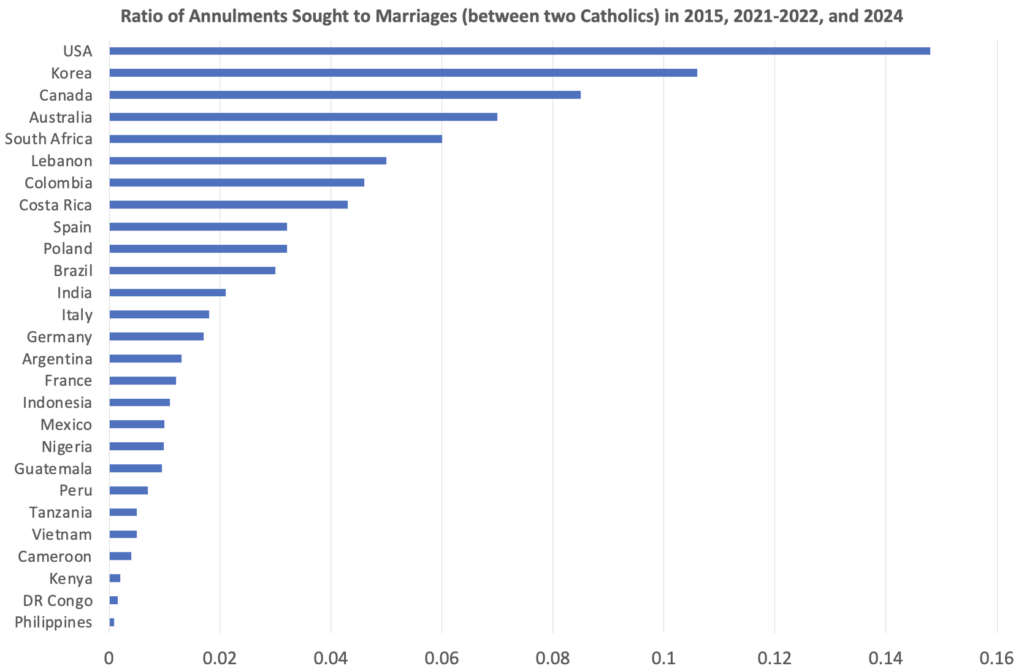
Graph created from information in Annuarium Statisticum Ecclesiae 2015, 2021, 2022, and 2024. Libreria Editrice Vaticana.
The United States displays the highest annulment-to-marriage ratio in the world (0.148), meaning there is around one annulment case introduced for every seven weddings. Korea reports just over one annulment for every ten weddings, and Canada for every thirteen. Historically Catholic Europe is in the middle, at one annulment for every sixty-three weddings in Italy, sixty-four in Germany, and eighty-six in France. The Latin American countries here exhibit varied ratios, while Africa (and the Philippines) show notably smaller ones. For example, the Philippines reports one annulment introduced for every 1,273 Catholic weddings. Remember: these are not about civil divorce decrees, and it may well be that plenty of those in failed unions in some countries simply never pursue an annulment.
In keeping with its elevated trendline, the United States reported 14,023 annulment proceedings introduced in 2024 (not shown in the graph). By contrast, 2,404 annulments were introduced in Mexico, 400 in France, 208 in the Philippines, seventy-eight in Kenya, and twenty-eight in Cameroon. There is more to these numbers than simple differences in demand for annulments. In some locales, the (church) judicial process for pursuing an annulment is laborious and often understaffed. Canon lawyers are more numerous in the West, though they are not absent elsewhere. In other places, annulments are culturally proscribed or popularly perceived to be difficult to get. In secularized Europe, there is simply less interest in pursuing an annulment after a divorce. In Lebanon, there is no civil marriage or divorce at all—it’s a religious matter by definition.
In the United States, none of these scenarios holds. What remains obvious, however, is the American impulse to split and recouple; I don’t believe it’s because Filipinos and Kenyans like their marriages more.
We didn’t always think this way. Sociologists studying the attitudes and behaviors of American mothers of young children back in 1962 observed that half of them believed that parents of children should not stay together if they “don’t get along.” In other words, amoris patientia was a bit more taken for granted. Just fourteen years later (in 1976), that figure had leapt to 80 percent before leveling off at 83 percent in 1993. Sociologists assessing marital sentiments across nine European countries observed the same theme. In a de facto but not de jure manner, the post-conciliar era eroded popular conviction that marriage is sacramental, holy, and connected to procreativity. Vocations of all sorts hit the wall, and it signaled the beginning of a now-sixty-year struggle over human sexuality, the meaning of self-gift, and our ability to keep marital faith.
What does all this suggest? Under current social conditions, the sensus fidei fidelium is apt to vary by region in its historic support of the Church’s stable teachings on marriage and sexual relationships.
One European voice, newly recovered, inspires restraint. Ida Friederike Görres was an Austro-Japanese laywoman and scholar, born in 1901, whose extensive writing on marriage was only recently made available in the English language. Her book What Binds Marriage Forever is short, frank, and compelling—a rich and varied treasure of observations, questions, and occasional exasperations. Görres died suddenly on May 15, 1971, one day after having exhorted the German bishops in the early days of the (West German) Synod of Würzburg, an event which included laity in decision-making roles alongside bishops fifty years before the most recent synod. She was eulogized by her younger friend Fr. Joseph Ratzinger, who described her voice as “irreplaceable to the Church.” Her character, he noted, was one of loyalty and unrestrained cheerfulness, absent any rigidity or fanaticism.
Görres considered “the right of the Christian … to change partners legitimately” tantamount to “the right to permissible serial polygamy within the Church.” This may strike some as unnecessarily inflammatory language, but thoughtful scholars reinforce her perspective today. As one of several examples, Princeton University sociologist Dalton Conley refers to the pattern Görres describes as “dynamic polygamy,” because even though spouses may split and move on to new unions (including marriages), some terms of the original union’s obligations linger for decades. That is, significant aspects of a marriage—things like material and financial child support, and the sharing of assets, responsibilities, and time—don’t actually conclude with divorce. Nor does it matter if we tell each other that the first marriage was “erased” through annulment. Legal, personal, and moral commitments remain, even while we seek to establish such commitments with a new person.
Görres, long dead by the time these annulment data were published, observed what the graph above still conveys about the sub-Saharan Church: “The African bishops are there, unconsciously, as representatives of a consensus, which encompasses the entire history of humankind on almost the entire globe.” What sort of consensus do they represent? That marriage, until recently, was not utterly equated with romantic love (and hence fragile). Görres was suggesting that outside the modern West, marriage still remains pivotal for basic survival and thriving. There, spouses are far more dependent on their marriages, and extended family is how one “makes it” in conditions of greater scarcity. It’s what marriage was about virtually everywhere (except among the rich or royal) until the twentieth century. The idea of responding to amoris patientia by leaving an unpleasant marriage is far more unlikely in places like the Philippines, Congo, Kenya, Cameroon, Vietnam, Tanzania, and Peru. Whether it’s a subjectively happy union takes a back seat to whether it’s an objectively functional one. Death and divorce are experienced there as profound social and economic trials for families in a manner less familiar to the wealthier West.
Whereas “a particular idea of ‘happiness’ … in the erotic-sexual realm” seems demanded for marriage to work in the West, mutual fondness, argues Görres, is ample and better suited to the human person. The former principle, she insisted, was responsible for the ecclesial resistance to canon law she discerned in Germany in 1971, which has deepened in the decades since. Görres directs attention back to a sacramental and sacrificial understanding of marriage when the world around us pushes a more political arrangement concerned with rights, power sharing, bargaining, and fear of domination, all held together by subjective happiness.
We have a choice. We can look at the Church’s teaching on the indissolubility of marriage as burdensome, backwards, or downright bizarre, or we can look at it as Görres describes, “as protection, preservation, guarantee, rootedness, as the greatest earthly security of all which one person can give to another—and, moreover, as a reflection of God’s immutability.” Long before my wife and I were Catholic, this was a part of Church doctrine we had both come to believe—that our marriage was an entity of its own that we had birthed but had no right to kill. It has been a shelter from storm. Of course we have witnessed amoris patientia. It’s part of the deal, Görres reminds:
Anyone who understands marriage as the lifelong bond of two people … knows or should know that all possible difficulties and crises have been factored in from the start. As the wedding liturgy acknowledges: “for better and for worse, in health and sickness. …”
It could never be just about “for better” and “in health.” But isn’t there a limit to trouble, irritation, addiction, betrayal? Görres responds with a question of her own:
When one partner ravages his soul, is not the other one called all the more to go to battle with him for his sake? Is this obligation rescinded by the separation that may have become necessary? Quite on the contrary. The door must remain open.
For how long? Until what happens? Tougher medicine still, though befitting a robust rather than a tepid commitment to marriage:
If the other one does not come back, the one who remains behind will accompany the one who has departed with prayer, and, most importantly, with atonement: responsible for him or her until death.
I realize these are blasphemous sentiments to the average Christian—Catholic or Protestant—who has his limits in what he is willing to tolerate. But mirroring Jesus’s undying fidelity to his oft-faithless bride is not just admirable. It’s possible. It is walking in his steps, a “white” martyrdom of sorts.
Should it be expected? Amoris Laetitia is for realists, which means that regardless of whether we expect undying fidelity after a collapsed marriage, it will be uncommon in its instances. I don’t begrudge priests the decisions they must make in their discernment, counsel, and care, as AL details. Görres herself empathizes, highlighting alternative penitential approaches for the Church to consider. And yet she came to learn that the hard path of discipleship amid marital dissolution was nevertheless possible:
I understood this for the first time—and ever since then—when an abandoned, divorced woman … said to me: “Now I have to be faithful for two.”
I once knew such a woman, a Catholic schoolteacher from my Protestant youth. First, her eldest son was killed at age twenty-seven in a commercial airline crash in 1987. Then her husband left her. Decades later, he died. Then her other two children died, also prematurely. And finally, having witnessed it all, she too passed away. I don’t know if she was a saint. I just know that, with the help of faith and vibrant friendships, she offered up what was dear to her—her marriage and her family, one by one—to God in his wisdom, all the while keeping faith. That can’t not matter.
On every August 29th, the Church celebrates the Feast Day of the Passion of Saint John the Baptist. Unlike most martyr saints, the Baptist didn’t die for testifying to the Christ. Rather, he was executed because he held that marriage isn’t merely a private matter for us to do with as we choose, but rather a public one subject to the moral law. John refused to remain silent when the king wedded his brother’s estranged wife and then demanded the public respect it as the legitimate marriage it wasn’t. For that, perhaps the Baptist could become the patron saint of those whose love entails great suffering.