St. Augustine once declared that all he desired to know was “God and the soul.” One would be hard pressed to find a pithier summary of the aims of his thought. In his Confessions, he wonders at the fact that both God and the soul seem to exhibit an inexhaustible depth that the intellect cannot fully grasp. He ponders what he is “loving when he loves God,” and thereby “becomes a question” to himself. For Augustine, the question “who are you, my God?” is somehow related to the question of what we moderns might call the “self,” yet for Augustine, both ultimately retain an inscrutable depth.
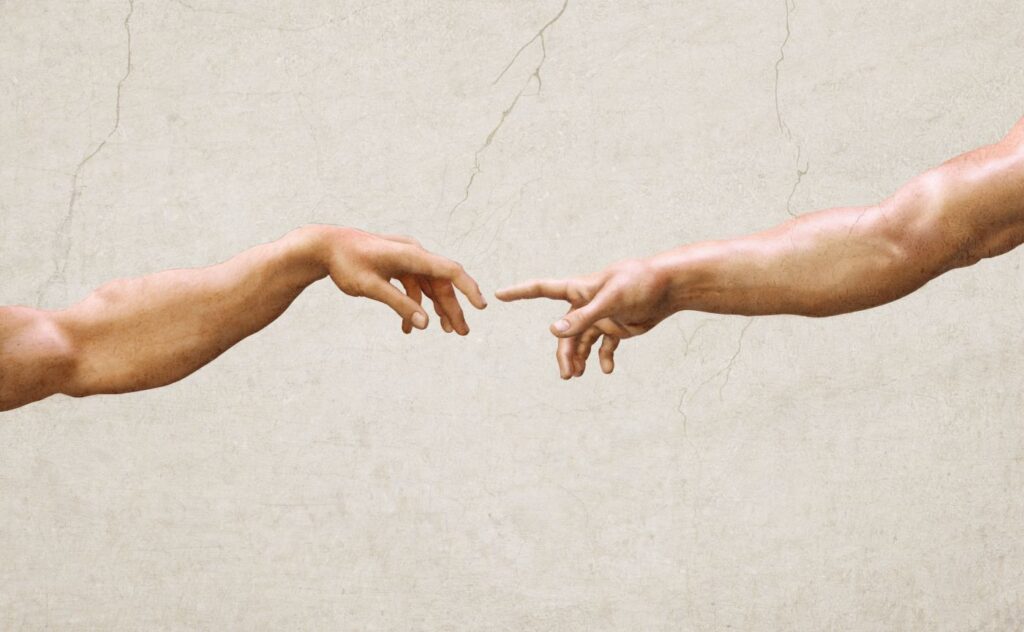
In interpreting these philosophically rich but difficult passages, one might wonder: is Augustine more interested in God or in himself? Those who endeavor to incorporate Augustine into an intellectual history of modernity are prone to emphasize the latter. According to such accounts, Augustine is a key player on the path to modern individualism: his search for God is really a search for the self. Yet what is often unaccounted for in this genealogical reading is the truth of the structure Augustine identifies: God and “self” are inextricably intertwined. One cannot be understood without the other. The interpretation of the meaning of this structure, particularly what it might mean for us morally, can be read as one possible driver of history. The questioning search of the depths of God through my own interiority is one way of understanding the meaning of the Judeo-Christian doctrine that all human beings are made in the “image and likeness of God,” what Latin Christendom came to call the imago Dei.
Tomer Persico’s new book, In God’s Image: How Western Civilization Was Shaped by a Revolutionary Idea, questions the dominant genealogy of liberal individualism along these lines, if implicitly. His goal is to demonstrate that interpretations of the imago Dei have exercised a decisive influence on the history of the West. This idea has important implications for our secular modernity; it continues to shape how we think about ourselves and our world today. However, unlike Brad Gregory, Jacob Burckhardt, Michael Gillespie, or Larry Siedentop, Persico does not seek the seeds of modernity in the Reformation, the Renaissance, or in the Medieval period. Rather, he argues that a key driver, perhaps the key driver, in bringing about Western modernity is to be found in the ancient Jewish doctrine of the imago Dei. It is a fantastically ambitious project, ranging over some 3,000 years of thought regarding “the stories we tell about ourselves,” which has led to our late modern, liberal conceptions of the “individual.” These shifts have implications for secularization, the status of European Jews in the Enlightenment, legal personhood, liberal toleration, and the relationship between science and faith, to name just a few areas that Persico explores.
But there is more here than historical argument for its own sake. Persico’s goal is to show that such changing conceptions of what the imago Dei means lead to a “moral obligation to explore how our traditions and ethical frameworks should respond” to changes in the way that doctrine is interpreted. In other words, this doctrine does not present itself to us as a static object of conceptual knowledge, but demands interpretation and reinterpretation across time. Most importantly, we are morally bound to take that historicity into account as we navigate our various social and political crises.
In the end, the book is magnificently conceived, if a bit flawed in execution. It is exactly the right kind of history we need, one that demonstrates why we must keep thinking about the imago Dei as we fight through the pathologies of late modernity. But its lack of historiographical specificity ultimately leaves the book more suggestive than conclusive.
Start your day with Public Discourse
Sign up and get our daily essays sent straight to your inbox.In terms of pure historical ambition, the book is impressive, and in many cases adds much to the conversation on the threads it picks up. Sections on Moses Mendelssohn, the Scientific Revolution, and the “Myth of Enlightenment” make the volume well worth the effort on their own. Perhaps its greatest success comes in its confirmation of what thinkers like Jan Patočka, Eric Voegelin, and Bruno Snell have also surmised: that properly conceived, “history is foremost a history of the soul,” in the words of Patočka. That is, history ought to be read, at least in part, as a response to the question of what it means to be human. Persico gestures toward such an awareness through the structure of his argument, a refreshing departure from the approach of other popular historians like Yuval Noah Harari or Jared Diamond.
Thus, Persico views the authors of Hebrew scripture, Christian thinkers like St. Paul, Augustine, and Martin Luther, and Enlightenment thinkers like Denis Diderot as vital precursors to our own modes of thinking about what it means to be made in God’s image. Unfortunately, the grandiosity of the study, combined with his effort to make it accessible, ends up detracting from the quality of the moral and philosophical aspects of Persico’s project. This is perhaps understandable, given his evident desire to reach a more general audience; but he succumbs to the temptation to sand down sharp edges of philosophical nuance to maintain his genealogical argument.
Take, for example, the aforementioned question whether Augustine is more interested in knowing himself or God. For Persico, it is the former that clearly takes center stage. He paraphrases Augustine by saying that “He was asking God not to reveal himself (God) but himself (Augustine), so that he could know himself.” There are a number of contestable claims hidden in this attempt at clever paraphrase, all of which go undeveloped, even in the endnotes.
A similar issue arises in Persico’s treatment of the imago Dei in early Jewish thought. He writes that “humans were created in God’s image, meaning that they themselves are the image instantiating God’s image.” Much turns on the meaning of the word “instantiation” here. Persico’s account suggests that it indicates an exclusively corporeal meaning. Thus, “God’s image does not symbolize him but rather presents him, or expresses his presence” (emphasis in original). So far so good; but he continues: human “bodies are the image of God: the presence of the one true God.” But readers may be left wondering: is instantiation of God’s image in the human body the only way these early monotheists understood this image? The confusion on this point continues when Persico explains the commandment against worshipping graven images. In his account, to make such an image would be an offense against humanity as the instantiated God: “Jews must therefore reject idol-worship and embrace human-worship as a means to the worship of God.”
To be sure, there are reasons to suppose this might be the case; witness Abraham’s encounter with God in bodily form in Genesis 18. But even granting Persico’s heavy emphasis on the strangeness of these early interpretations of Jewish scripture, his explanations confuse more than they clarify.
Though it may have been “obvious” to ancient Jews that “God had a body,” to explain such a belief using terms like “human-worship” risks flattening the richness of Jewish theology evident in even a cursory reading of the Hebrew Bible. For example, at the dedication of Solomon’s Temple, “the cloud filled the temple of the LORD,” and “the glory of the LORD filled his temple” (1 Kings 8:10–11). Likewise, God promises to meet Moses and speak “from above the mercy seat, from between the two cherubim” (Exodus 25:22). Or, God’s presence before the Israelites in the pillar of cloud during the Exodus: “And the LORD went before them by day in a pillar of cloud to lead them along the way” (Exodus 13:21). Ancient Israelite religion could therefore affirm a real divine presence without necessarily collapsing such presence into corporeal embodiment. Persico does not address the possibility that ancient Jewish belief might have had room for God’s immanent presence as well as his transcendence.
In other cases, Persico adds suggestive glosses to subtle and difficult issues (his views on Pauline interiority, the Platonic soul, Kantian autonomy, or his problematic assertion that premodern religious rituals “failed to arouse … any special sentiments or experiences”). In short, Persico’s philosophically loaded interpretive moves, though they bolster his argument for a reconsideration of the secular liberal interpretation of the imago Dei, end up threatening the book’s historical persuasiveness.
The book suffers from a lack of clarity in other ways as well. In his desire to call attention to the role interpretations of the imago Dei play as a driver of historical and social change, Persico leaves the reader wondering what this narrative implies about the explicitly moral claim underlying his historical project. His hermeneutical approach leaves unresolved whether the imago Dei names a truth about the human person or is merely a historically productive symbol whose meaning changes across time. This unresolved tension makes his conclusions difficult to sustain on the basis of historical genealogy alone. In the Afterword, he asserts that the “idea of the image of God compels us to see the divine in another, their unique, irreplaceable value, which stems from their subjective exceptionality.”
Persico succeeds in showing that, though we may never reach final knowledge of the meaning of the imago Dei, it places a moral burden on us that we cannot escape.
Though it is refreshing to hear such conclusions from a historian, they seem to clash with his historical approach. The simple fact that we might reinterpret the imago Dei in a manner that differs from its currently prevalent secular liberal manifestation does not mean that we ought to do so. Only the truth symbolized in the imago Dei can compel in a moral-philosophical sense. Persico seems aware of this fact, but does not make it thematic in his analysis. A more forthright account of his historiographical assumptions, which I believe are correct, would have been helpful.
Nevertheless, Persico’s book succeeds in showing that, though we may never reach final knowledge of the meaning of the imago Dei, it places a moral burden on us that we cannot escape. This insight alone makes the book worth reading and earns Persico a place alongside more interesting contemporary historians like Tom Holland and Brad Gregory (though similar insights are better developed elsewhere).
In the end, Persico suggests that perhaps there is more to history than an agonistic succession of fables we tell ourselves about ourselves. The structure of the imago Dei is a constant that reveals the structure of history, though it does not provide final answers. It is, rather, an invitation into a search that we are all responsible for carrying out in our own lives. Accordingly, we ought to follow Persico in questioning the assumption that we have reached “the end of history” in our secular liberal account of the person. Instead, we might begin by asking, as Augustine did amid the disorder of his own age, who are you? In doing so, we might find a response, if not a conceptually exhaustible answer, to the related question that so haunts our world: who am I? If conceptual ambiguity on a subject as rich as the imago Dei is something that we must live with, however, we need not therefore abandon our search for the truth. In this sense the imago Dei might indeed be viewed as a driver of our Western, Jewish, Christian, and modern history.
Despite the drawbacks of his approach and the unfortunate flaws in execution, Persico succeeds in showing that history is not a never-ending succession of contingent self-descriptions. It is one ultimately constituted by our questioning search for God who, as Abraham Joshua Heschel reminds us, is always himself “searching for man.”