This essay is the first-place winner in the annual Public Discourse essay contest. Students were to respond to the prompt: What do you wish your elders understood about the greatest challenges your generation faces?
Congratulations to Stefan McDaniel, a tenth-grade student at St. Thomas More Academy in South Bend, Indiana.
“To handle human lives with no agreement as to what human beings are or what the purpose of life is—that is a formula for chaos.” This quote from Frank Sheed’s Theology and Sanity shows the root of the problems our generation faces. We are in a time of great technological progress and scientific discovery. However, we are coming up against difficulties no humans have ever experienced. These difficulties threaten to change the way human society works and humans’ place in creation. At this critical time, we have lost our knowledge of what it means to be human. Only if we can regain this knowledge can we hope to find our place in the world and mature into confident and fulfilled human beings.
The Culture at Speech and Debate
I am a member of the National Speech and Debate Association. Throughout the fall and winter, we compete in various categories of speech and debate. This provides a great opportunity for middle and high schoolers to develop speaking skills. However, the types of pieces that students choose to present are appalling. It is rare for me to enter a round and not hear a piece about suicide, rape, or homicide.
Start your day with Public Discourse
Sign up and get our daily essays sent straight to your inbox.At speech and debate tournaments, I see clearly that many members of my generation are not being raised with an understanding of the purpose of life and what we are as human beings. This lack of a foundation in truth leads students to become obsessed with death because, without hope after life, one must always be aware of the finality of death. One common topic for speech pieces is juvenile suicide. Students choose to tell others about members of our generation killing themselves for not particularly good reasons. Most of the pieces do not portray suicide as a good, but the fact that they are talking about suicide at all when it is not necessary shows an unhealthy obsession with death. It also brings suicide to mind, which may often promote similar behavior. Apart from this, though, obsession with death is indicative of deep moral instability and pain.
This moral instability is also manifested in the behavior of many members of my generation. Surprisingly enough, throughout the speech and debate season, I regularly heard two high school students performing victim statements that had been given by rape victims at their assailants’ trials. At one memorable time, one of my fellow competitors, performing a speech given by a victim of Larry Nasser, singled me out in the audience as Nasser and directed words originally spoken to Nasser at me during her whole performance. These speeches did not display Christian forgiveness, but were full of bitter resentment and resolve not to forgive. This kind of defiance against past values shows clearly the moral decrepitude of our generation. Many in our generation are showing increasing stubbornness and reluctance to adhere to values that have not been explained to them. The consequences seem to be a deep unhappiness evident among many students I have seen at various events. The faces of my peers appear unhappy, troubled, and disillusioned.
This issue is not new to our generation. For centuries, we have been losing touch with reason and with the divine. The first humans were predominantly polytheistic. They saw from nature the existence of the supernatural. Belief in the gods gave the duty to act in accord with their wills. This was not a “categorical imperative,” but a necessity for self-preservation. With the age of Christianity, Judeo-Christian morals took root in Europe and the West and taught of a deeper meaning behind morality. With the Enlightenment and the French Revolution, many started to doubt the reason behind morals and even lost belief in God. Such views have become more and more accepted (and even expected) among intellectual circles in the intervening centuries. More recently, widespread lack of religion has swept through many of the world’s most developed countries. Religion has been replaced by science for many. This is having its most devastating effects in our generation because children are being taught not to believe in God or, possibly worse, are not being told about Him at all. Instead, we are being taught how everything is explicable through natural processes. The culture at speech and debate tournaments shows clearly the effects of this. Humans are supposed to find God through nature (as the pagans did), and failure to do so results in our higher desires being oriented lower, to nature. But our higher desires cannot find satisfaction in something lower than God, and instead seek in vain for something they have refused. This is shown by the obsession with death and rejection of traditional values.
The problems of morality and purpose in life facing our generation are only augmented by social media. As is much talked about currently, members of our generation are spending on average more than half their days on screens. In addition to wasting time, the internet is what has allowed our culture of pleasure and death to spread. Ideas on social media are quickly amped up and circled around in a vicious cycle, promoting rapid growth of morally problematic ideas. This promotes anxiety to fit in with a world where everyone can see you. Additionally, it opens up pathways of bullying that can prove extremely detrimental to those too caught up in the virtual world. Moreover, spending so much time on the internet lowers attention span and increases distraction. This makes it harder to properly focus on more important aspects of human life.
Reasons We Have to Worry
Due to the great changes facing our generation, it would appear that we are standing on the shoulders of giants who have walled us all in with mountains. Our only escape is upward: we must go into the metaphysical realm and learn what it means to be human. Then, armed with this understanding, we can climb the mountains and carry on the mission of human progress.
The most revolutionary change affecting our generation and the one most talked about is the development of AI. We are coming to adulthood in a world with very different prospects from the times before us. It is possible that the world will be increasingly run by AI, and it is not clear what our place will be in such a time. We are trying to find our place in the world, but it seems that humans are good for different things than we previously were. Many are now proposing that humans will be subjected to, or even eradicated by, our own creation. These changes pose a major threat to how humans will live their lives. Our generation will see whether humans emerge as masters of technology.
How We Avoid These Dangers
To escape the consequences of a world dominated by AI and other modern technology, we must learn wherein lies our humanity: what makes us human. The materialists cannot find the thing that sets us over AI other than that we have made AI and are biological. To them, even being biological is no more than being a complex relationship between molecules: an advanced computer. If both humans and LLMs are computers, and AI is able to work more quickly and better, why shouldn’t AI run society? If human society is really no better than chatbots “talking” with each other on social media platforms, why do we even bother to live among each other?
Fortunately for us, though, we are not computers. We have a nature above our sub-creation, a creator above the material world, and a higher purpose and destiny. Keeping in mind our purpose as humans and how we should live, we can effectively steward over creation and use our sub-creation to advance our species and the world.
Many of our elders, however, are not conveying these truths to us. Most public schools promote Christian values, but without Christianity. Teachers and other members of the generations before us have been taught to value Christian ideals in many ways. These principles are then taught to students as the final end. Knowledge and practice of the virtues is a necessary part of reaching heaven, but, without recognition of God’s existence, all attempts must miss the mark. Students are being told how they should behave, but are not being told why they should behave in this way other than ideals such as “empathy.” This is not a way to promote virtue and peace in the world. Loosely Christian values are sometimes taught in schools, but in the wider culture, many people support violence and rejection of traditional ways of life. Going back to my experience at speech and debate, the pieces about violence win the competition without fail. This is not usually due to the superior speaking ability of the performers, but because the judges promote it. This unhealthy worldview is being encouraged by our elders.
The great men of the past have left us so much wisdom about how and why we should live, but we are leaving it behind in our own pride and confidence in our own ability.
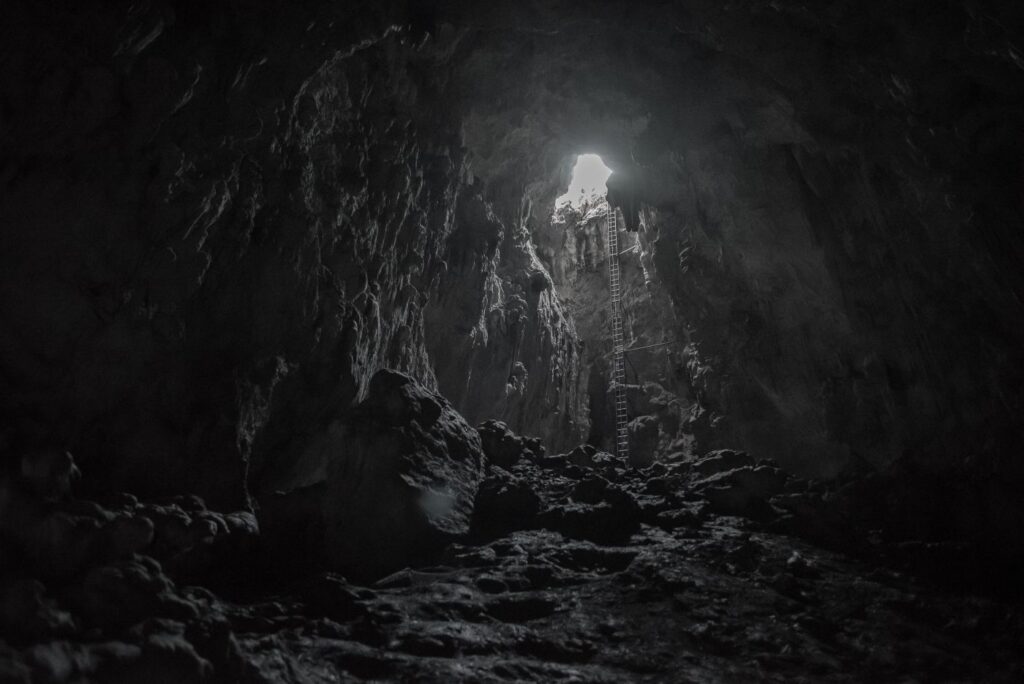
The great men of the past have left us so much wisdom about how and why we should live, but we are leaving it behind in our own pride and confidence in our own ability. This calls to mind the famous cave allegory in Plato’s Republic. In this part of the dialogue, Plato is conversing with Glaucon about men who have been chained in a cave watching shadows of the real world all their lives. The outside world is the world of metaphysics and deeper understanding, but the inmates of the cave cannot understand this fact, knowing only the inside of the cave. In the scenario, one of them is forced out of the cave and gradually learns to recognize and value the outside world. When he is brought back to the cave, he is no longer accustomed to the darkness and cannot make out the shadows on the wall as clearly as he was once able.
This allegory can show the path of humanity. We came like animals, knowing only the material world, but slowly, we gained knowledge of the higher order of things and learned about God and his relationships with men. Now, though, we are returning to our ignorance of the life we are meant to live. Just when the outside world could become even more brilliant through our creation, we are returning to the cave and accepting a darkness even more dark than when we first came to exist.
Unless the members of our generation can learn how and why we exist, humanity cannot hope to properly steward over nature. This is the task of the generation before us. We must be taught the truths that the ancients found and that humanity has since lost. I ask that all those involved in the mission of education redouble their effort to effectively convey these timeless truths to all of us. The way to live cannot be a secret held by a select few, but must be held by the entire generation. We are trying to make a world for ourselves like all the generations before, and we must be given the knowledge necessary to reclaim our human dignity.