If reports are correct, religion is regaining ground among young people in America and elsewhere. But in absolute terms, the number of religiously observant Westerners remains historically low, while the number of religious “nones”—atheists, agnostics, and the indifferent—is higher than ever. What could believers do to help turn the recent uptick in theism into a larger religious revival?
Spreading traditional rational arguments for God’s existence, like Thomas Aquinas’s five proofs, may not be very helpful. Those arguments presume their hearers agree that unchanging, transcendent truths exist, and that it is better to live by them than not. But many today lack such convictions. Critical Marxists believe that transcendent truth is irrelevant to people’s real needs. For them, “the reality or non-reality of thinking” is determined only by what works in “practice.” Those who reason according to transcendent principles and logic, they say, only seek to force their preferences on others; all rational argument is rationalization. Truths are at best the findings of empirical science, which are continually being revised; truth is not a timeless reality existing above us. Technocrats who accept such materialism, but not Marxism’s disruptive, revolutionary spirit, seek to subordinate religion, and all truth-seeking idealism, to material “well-being.”
Then there are the countless masses who experience life as if God did not exist, even if they think of themselves as religious. They find life “disenchanted,” thin on meaning, each day feeling like just “one d— thing after another.” For many, life seems like a game directed by forces beyond our control, be they “evolution,” “the market,” “the deep state,” or social media algorithms. Our lives are organized by technology that most of us don’t understand; we trust technology, and “the experts” who make it, simply because it works. And yet the experts don’t always understand what they make, as with so-called “artificial intelligence.”
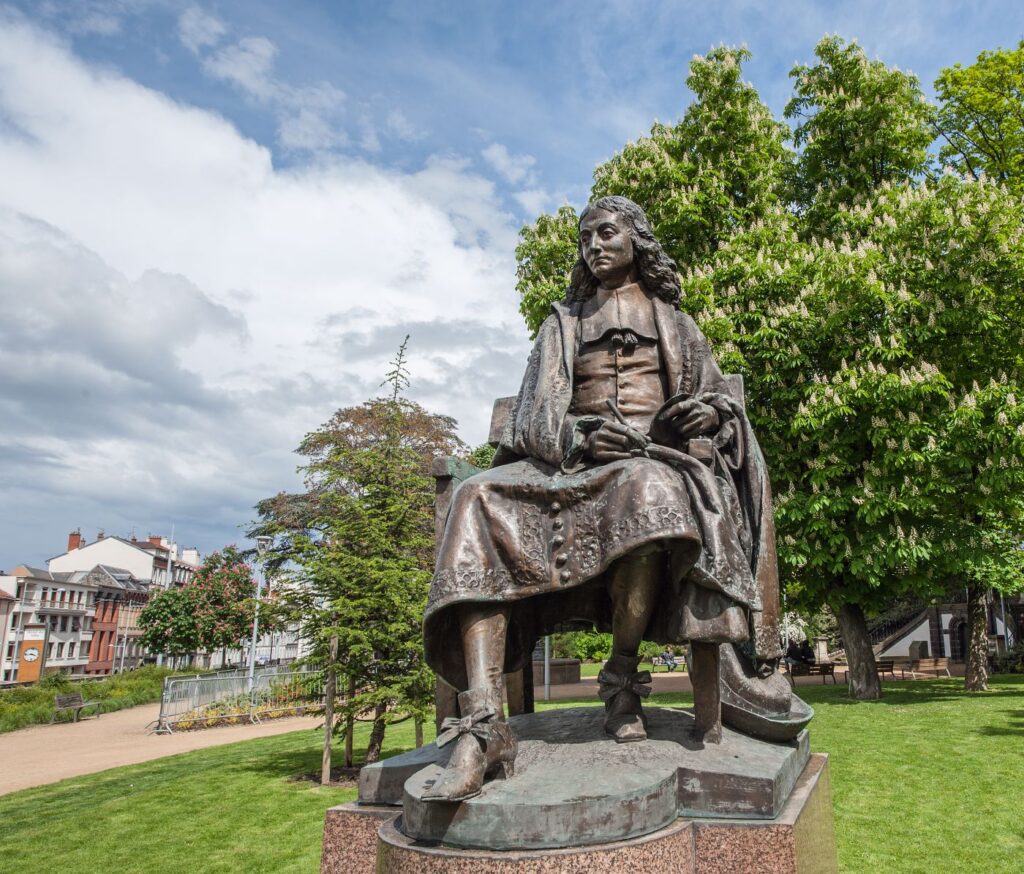
Appeals to absolute truth, moral or otherwise, are unlikely to persuade people formed in the practical, experimental logic of our time. A better defense of theism might rather take the approach of the seventeenth-century French mathematician and philosopher Blaise Pascal.
The Game of Life
Start your day with Public Discourse
Sign up and get our daily essays sent straight to your inbox.The France of four hundred years ago was no secular technocracy, but parts of it were beginning to experience the same spiritual disillusionment that pervades our world today. Wearied by religious wars, and impressed by the new empirical sciences, many of Pascal’s educated peers began to doubt the existence—or at least the relevance—of transcendent truths that could not be proved by scientific experiment.
These doubts were especially strong when it came to the question of God. As Pascal put these skeptics’ argument:
If there is a God, He is infinitely incomprehensible, since, having neither parts nor limits, he has no affinity with us. We are incapable, therefore, of knowing either what He is or if He is. That being so, who will dare to undertake to decide this question? Not we, who have no affinity with Him.
In response, Pascal decided to write a book in defense of theism, and of Christianity in particular. He never finished it, but many of his notes were preserved and published posthumously as the Pensées—“thoughts.” One of the longest notes, and perhaps the most famous, is “The Wager.” In it, Pascal presents an argument for theism different from those of Aquinas and other premodern apologists for religion.
Pascal grants the skeptic’s judgment that God’s existence could not be known by reason; after all, St. Paul admits that Christianity appears as “foolishness” to those who do not already believe. However, Pascal counters, reason’s alleged inability to know God is an insufficient argument against religion; because if, as the skeptic claims, reason cannot determine whether God exists, neither can it answer the question whether to believe in him. Either position becomes a kind of opinion, an assent by decision, in which the will must move the person to believe—or not—because there is not enough rational evidence to draw the intellect to assent on its own. And if there can be no evidence, the decision must be completely arbitrary, as in a game of chance such as a coin toss: although the respective chances of heads or tails are knowable, one cannot predict by reason which way the coin will land in any toss; one can only bet.
So, Pascal asks the skeptic, “What will you wager” on God? He proposes (more or less) that if God exists, it is infinitely better to believe in him, and therefore go to heaven, than to reject him, and therefore be damned eternally. If God does not exist, and there is no afterlife, then believing in him does no harm, and it has benefits in this life, such as the believer’s growth in moral virtue as he strives to be worthy of heaven. Therefore, the better bet is to believe in God.
Many have questioned the correctness of Pascal’s reasoning. Some note that if God really is incomprehensible, then even if he does exist, we cannot know that he rewards those who are good; or perhaps he punishes people that lack sufficient reasons for their beliefs. Many such objections could be answered by traditional defenses of theism, like Aquinas’s metaphysical proofs. Unfortunately Pascal can hardly invoke such help, because he is something of a skeptic himself. He does say that “[i]f we offend the principles of reason our religion will be absurd and ridiculous,” but he also disparages “metaphysical proofs for the existence of God” as “so remote from human reasoning and so involved that they make little impact.” He even questions the first principle of metaphysics—the principle of noncontradiction—saying: “Contradiction is no more an indication of falsehood than lack of it is an indication of truth.”
But these weaknesses do not undermine Pascal’s most important point. The Wager’s power lies less in the certainty of its final conclusion (that believing in God is the best bet) than in its starting insight: that the uncertain perspective of skepticism—which suspends judgment about the metaphysics of things (the ontological principles that explain their unity, purposefulness, and the like)—works as much for theism as against it. If one doubts the existence of unchanging metaphysical realities—whether with the hesitation of the skeptic, or the confidence of the atheist—one accepts the possibility that reality, although it appears orderly to all of us, may be grounded in unintelligent processes as random as the outcome of a coin toss. But if it is possible that the reason of all mankind could be so deceived—perceiving a fundamental order where it does not really exist—human reason must not have a necessary connection to the real world. There must not be anything in our knowledge that is always correct, whether the first principles of morality in the conscience, or the first principles of existence (such as the principle of noncontradiction). Each mind is like a man adrift at sea, without even a plank of wood to cling to, drowning in a chaotic universe. If human knowledge is as uncertain as that, it is at least as acceptable to believe in God as not.
Therefore, Pascal admonishes his interlocutor, “do not attribute error to those who have made a choice [for God]; for you know nothing about it.” In the skeptical frame of reference, the theist’s belief is unknowable—incapable of being rationally analyzed—because it is not rational. But so too is the atheist’s disbelief. In a mental framework with no anchor in objective truth, to positively deny the existence of a Being who is Truth must be, not a conclusion deduced by reason, but a choice so stripped of reason as to be an act of faith, as radical as that of the most antirational religious fundamentalist.
And agnostic skepticism, into which Pascal imagines his interlocutor retreating, is not even a possibility. “I blame [theists],” the skeptic retorts, “for having made, not this choice, but a choice; … both he who chooses heads and he who chooses tails are equally at fault. … The true course is not to wager at all.” To this Pascal replies: “Yes; but you must wager. It is not optional. You are embarked,” or as a freer translation puts it, “you have joined the game.” Either with Nietzsche we renounce God and strive (in vain) to “become gods ourselves,” filling the emptiness of a godless life; or with John of the Cross we accept our dependence on almighty God and embrace the path of self-emptying love that leads to the fullness of joy. There are only two possible ends to human existence: living for oneself alone, or living for the transcendent Other, and through him for all others.
There are only two possible ends to human existence: living for oneself alone, or living for the transcendent Other, and through him for all others.
Perhaps It Is True After All
Some skeptics or atheists may claim to be committed to truth and reason. But if they are sincere in that claim, they have left the world of random chance, apart from which atheism is untenable; they must eventually admit God’s existence, or so Maimonides, Avicenna, Aristotle, Aquinas, Leibniz, and others have argued. But if skeptics do stick to their guns and remain in a mental universe where life is a roll of the dice, appeals to what is certain are less likely to interest them. The theist would be better advised to frame the question of God as Pascal did, as a wager, although he might (unlike Pascal) simultaneously appeal to his interlocutor’s metaphysical intuitions. The argument might run like the following.
On which belief are you willing to stake the course of your life? That the sense of guilt or joy you experience at your actions is the product of random material evolution?—or that it is the quiet voice of a sovereign intelligence existing outside of you? Would you take a chance on believing that our orderly universe sprang into existence from nothing?—or rather that it was made by a wise Being who exists of his very nature? If the theistic explanation of the world seems more probable, why not try believing in God, starting by asking him for help to believe? If one sticks to that decision for more than a few days—enough to stretch one’s patience beyond one’s comfort zone—life might continue to seem like a game, but in a different way: not as one headache after another, but as a set of challenges that, if we meet them bravely, make us better, drawing out possibilities in ourselves we had not seen before. One might begin to feel less like a pawn shoved around a chessboard by an invisible hand, and more like a player on a sports field, accompanied and cheered on by God’s quiet but ever-present wisdom, who, as the Vulgate and other translations of the Bible say, “plays over the face of the earth, … delighting in the sons of men.”
Theists who make the case for God this way may be surprised at how it can move apparently confirmed skeptics. Today’s academic philosophers, most of whom have little religion, keep discussing the Wager centuries after Pascal formulated it; their persistent interest shows how intriguing, and perhaps unsettling, the Wager remains to the skeptical mind. In pointing to the uncertainty of the “faith” of atheism, Pascal can wake skeptics from the slumber of self-confidence, in much the same way that, according to legend, a rabbi once rattled an assured skeptic:
An adherent of the Enlightenment, a very learned man, who had heard of the Rabbi of Berditchev, paid a visit to him in order to argue, as was his custom, with him, too, and to shatter his old-fashioned proofs of the truth of his faith. When he entered the rabbi’s room, he found him walking up and down with a book in his hand, rapt in thought. The rabbi paid no attention to the new arrival. Suddenly he stopped, looked at him fleetingly, and said, “But perhaps it is true after all.” The scholar tried in vain to collect himself—his knees trembled, so terrible was the rabbi to behold and so terrible his simple utterance to hear. But [the] rabbi … now turned to face him and spoke quite calmly: “My son, the great scholars of the Torah with whom you have argued wasted their words on you; as you departed you laughed at them. They were unable to lay God and his Kingdom on the table before you, and neither can I. But think, my son, perhaps it is true.”