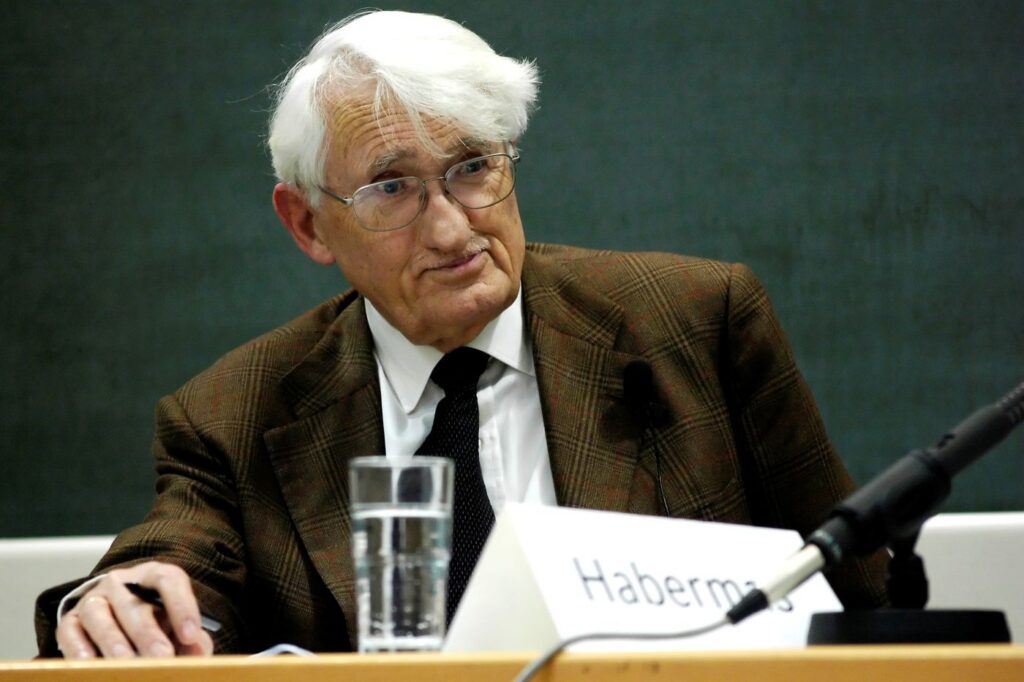
Jürgen Habermas entered my office in University College Dublin, where I was then lecturing in the Philosophy Department. It was April 1994, and he was there to give a public lecture on human rights and democracy. He was an immensely tall man with a noble bearing, one who was short on small talk despite being intellectually obsessed with speech and communication. He took tea, and we conversed about various political and philosophical issues. I remember thinking that he spoke as he wrote, in heavy-laden language full of Frankfurt School nomenclature. He had, of course, held the chair of Philosophy and Social Science at Frankfurt University in the 1960s and was thus heir to luminaries such as Theodore Adorno and Max Horkheimer. As such, he was a leading light of that branch of Continental European philosophy known as Critical Theory.
Unlike competing contemporary movements, such as phenomenology, structuralism, and hermeneutics, Critical Theory was dominated by quasi-Marxists who had abandoned the lust for what Bernard Yack famously described as “the longing for total revolution.” Indeed, Critical Theory has often been described as “humanist Marxism,” an obvious oxymoron that nonetheless gained traction because of its emphasis on culture as the arena for revolutionary critique. Zealots, like Stalinist Georg Lukács, remained in the hinterland of Critical Theory, reminding the new breed of their debt to the old guard who had fought the good fight in defense of ideological purity. However, with philosophers like Habermas and Herbert Marcuse, the struggle became more benign, since it no longer sought to offer intellectual justification for total revolution or Stalinist tyranny.
Chatting with Habermas, I was aware that I was in the company of one of the great figures of postwar European philosophy. However, unlike many of his contemporaries whom I had met and, in the case of Jacques Derrida, whom I knew personally, Habermas was devoid of charisma. He had gravitas but little sparkle, evidenced by the fact that he plodded through our conversation as though writing one of his notoriously long and convoluted sentences. He never laughed but adopted a tone of seriousness that seemed to be a badge of honor for those destined to dignify the corpse of Marxist materialism by draping it in a shroud of democratic respectability. Indeed, I found myself listening to a man who stood at the end of a long line of revolutionaries, but for whom that legacy seemed to be a heavy burden that he nevertheless felt obliged to shoulder. That said, he was a man of great decency who, unlike most avowed Marxists I have encountered, was neither suspicious nor paranoid. I got the impression in those hours that, despite his heavy heritage, he was genuinely seeking to offer intellectual substance for a freer and more just society.
The most bizarre moment of our conversation occurred when I said, “the last person to sit in that chair was Alasdair MacIntyre,” to which Habermas responded: “I must admit that I have always found MacIntyre very boring.” Compared to Habermas, whose copious writings were, by any standard, widely considered tedious and dull, MacIntyre was captivating. He indeed embodied a Scottish seriousness, but he was anything but boring. To ask MacIntyre a question was to invite a master class in philosophical clarity and reasoning. This surely should have appealed to Habermas, whose theory of communicative rationality and action was the centerpiece of his later work. My suspicion is, however, that, for Habermas, MacIntyre’s linguistic baggage—his vocabulary, as it were—was hamstrung by the “false consciousness” of an ideology that distorts communication. Ironic as this little anecdote may be, Habermas’s remark about MacIntyre reveals much about the shortcomings of the theory of communication that characterized nearly everything he wrote from the 1960s to the time of his death earlier this month.
Habermas never lost interest in the project of emancipation—a key term in the Marxist lexicon to which he was the most recent heir. Emancipation for him, however, is not emancipation of the proletariat from its capitalist-imposed chains. Rather, for him, all knowledge is directed by what he terms “human interests.” This means that knowledge is not value-free. It does not provide a neutral standpoint from which we can lay claim to objective truth. That is what he terms an “objectivist illusion,” one that seeks to bind genuine human action and communication to the demands of an instrumental and technological order. The aim is thus to shatter this objectivist illusion so that genuine knowledge and communication can open a path to what Richard Kearney describes as “the interest in emancipation as a basic human need for autonomy, responsibility and justice.”
Start your day with Public Discourse
Sign up and get our daily essays sent straight to your inbox.The problem with all philosophies of emancipation is, however, that they seek to scrape away the very means we possess to understand the world and to communicate according to norms, values, and customs that render us intelligible to one another. For example, Habermas insists that his critique of ideology must encompass the language of philosophy itself, and especially those recent movements, such as hermeneutics, that presuppose the traditions of a social, legal, and political order that precedes us. The language of this order is, thus, always already hierarchical and exclusionary. Consequently, we must go beyond the vocabularies of inherited legal, philosophical, theological, and political structures, which have been distorted by ideology. But how do we progress beyond such “deformed communication?” We must not reach for some illusion of undistorted communication that precedes us. Rather, we must aim for an “ideal speech situation” that has yet to be achieved. This is what it means to have an “interest in emancipation.”
The so-called “ideal speech situation” is a utopia in which there would be a fully democratic realm of communication undistorted by ideology. It is a situation in which all actors could speak with equal authority because they would no longer be burdened by, as Kearney writes, “the unequal distribution of dialogue opportunities which sustain privileged positions.” To reach such a position requires constant emancipation from a past where direct communication was, in the words of Kierkegaard, forever obfuscated by indirect communication. From this Habermasian perspective, MacIntyre would find himself on the wrong side of history because, even though he rejected the Enlightenment, he pinned his flag to Aristotle and Aquinas, both of whom belonged to an undemocratic system of communication. For the agent of emancipation, therefore, anything that is not totally and utterly new is condemned as “deformed” and, in MacIntyre’s case, “boring.” There is, however, a second and, from my perspective, a more serious consequence of Habermas’s emancipation project. When you seek to overcome the past, either through revolution or through the systematic cleansing of communication, you deprive social beings of the only means they possess of truly understanding themselves: their history and identity.
As Hegel understood, we mediate with our world through culture, language, and consciousness. Inherent in each, whether we like it or not, are norms that are exacting, for they bring us on a journey of self-recognition, ultimately leading to a sense of belonging we would otherwise be denied. What place, in other words, would Hegel himself, or Mozart, or St. Augustine have in Habermas’s ideal speech situation? Presumably, theirs would be an undemocratic form of communication. And yet, to be cut off from that treasury of tradition, knowledge, and cultural authority is to be severed from our ancestral home. It is to be, as so many are today, spiritually homeless. Put simply, the emancipatory goal of the ideal speech situation seeks a world without distinctions, without memory, and, most tragically, without belonging.
Ironically, the nearest we have come to such a world is one that I am sure Habermas would have decried. Does not the “nowhere” of social media offer a completely democratic sphere of communication where all voices have equal value, and where the “objectivist illusion” has been ripped away? In such a normless world, we don’t get any closer to genuine knowledge because all opinions, however baseless, are given equal weight. The lesson is that without authority, regulative norms, and traditional procedure, communication does not become emancipated from ideological distortion. If anything, it becomes distorted to such an extent that authentic communication is all but impossible.
Toward the end of his life, Habermas seemed to become more nostalgic for the things he once perceived as being impediments to “communicative competence.” He held a famous dialogue with Cardinal Ratzinger, who would soon thereafter become Pope Benedict XVI. During that conversation, he conferred a secular blessing on the old Judeo-Christian religions.
A few years before he died, I dined with Derrida in his favorite restaurant in Paris. I asked him if he had recently heard from Habermas. He pointed to a little table in the corner of the restaurant and said, “a few weeks ago, we sat for hours over there talking about many things.” The last great representative of Critical Theory had made a pilgrimage to the last luminary of the continental tradition. They each had their own liturgical language infused with the mysticism of Hegel, Marx, Horkheimer, and Edmund Husserl. And yet, somehow, despite not being in an ideal speech situation, they managed to communicate and find common ground. “We had a wonderful conversation, and we have agreed to stay in touch,” Derrida said, smiling, to which I could only reply, “Amen.”
Now, both men are gone. Habermas was the last great thinker of the modern European era. His death signals the end of continental European philosophy as I have known it throughout my life. Despite my critique of his thought, I recognize that, during those few hours in my office more than thirty years ago, I hosted a cultivated and highly educated philosopher, whose contribution to modern thought cannot be underestimated. That he sought to change the world, not by force or revolution, but by changing how we communicate, was highly laudable. However, in seeking to purge speech of ancestral voices, we deprive it of the very means we have of coherently communicating about the things that matter because they make us who we are.
That is why, in my view, the ideal speech situation is not Habermas’s greatest legacy. For me, it was his rejection of that virulent form of Marxism that had infected the tradition to which he became the principal heir. That he did so with such personal dignity will stand before future generations as an example that did not require speech, but simply the power of a silent witness.