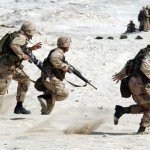
The United States is at war—and has been, continuously, for ten years. This is a reality, of course. But more than that, it is a legality. Legally—constitutionally—the United States has been in a condition of declared war for ten years.
On September 18, 2001, Congress enacted into law, and President George W. Bush signed, what is arguably the broadest declaration of war in our nation’s history. “Whereas on September 11, 2001, acts of treacherous violence were committed against the United States,” begins the Authorization for Use of Military Force (AUMF),
The President is authorized to use all necessary and appropriate force against those nations, organizations, or persons he determines planned, authorized, committed or aided the terrorist attacks that occurred on September 11, 2001, or harbored such organizations or persons in order to prevent any future acts of international terrorism against the United States by such nations, organizations, or persons.
Constitutionally, the 9-18-01 Act is a Declaration of War. Congress, not the President, has the power “to declare war,” the result of a deliberate decision by the framers of the Constitution to transfer the traditional war-initiating executive power of a king to a representative, republican legislature. The President, the framers determined, should have only the power to counter attacks on the nation—to repel and respond—but not to initiate war on his own. The President, as Commander-in-Chief, would have complete military authority to conduct war, once declared: he, and not Congress, makes the decisions as to how to wage war, including all matters of military engagement, strategy, tactics, rules of engagement, diplomacy, armistice, foreign relations with allies and adversaries, and policies toward captured enemies (including detention, interrogation, and military punishment—the subjects of so much friction in recent years). The framers’ division was clear: Congress declares wars; the President fights and concludes them.
Start your day with Public Discourse
Sign up and get our daily essays sent straight to your inbox.Congress’s power to declare war does not require the use of magic words. Congress need not say “declare” and it need not say “war,” and there may be practical and diplomatic reasons to couch a war declaration in terms more congenial to the regime of “international law,” which favors the language of individual and collective self-defense over the old-fashioned, indecorous language of war. But war it is. More to the point, constitutionally, the 9-18-01 Authorization for Use of Military Force is an exercise of Congress’s legislative power “to declare war.”
The AUMF is remarkable, even stunning, in its sweep. It accounts for and justifies nearly every military action in which the United States has engaged in the past ten years in fighting the war on terror. (Iraq was the subject of a separate, overlapping war-authorization. U.S. military action in Libya, as I will discuss, is not justified by the AUMF and is probably best classified as an unconstitutional war.)
Consider the AUMF’s expansive language. Congress declared war against not only enemy nations—the traditional form of a war-declaration—but also against organizations and persons. The sole condition is that “the President determines” that a nation, organization or person is connected, in any of a number of ways, to the attacks of September 11, 2001. This includes “harboring” any person or organization who the President determines “planned, authorized,” or—the most open-ended term—even “aided” the 9-11 attacks. Combining the links in the chain of legal authorization opened up by the AUMF, the declaration of war reaches any person, organization, or nation connected in a supportive or protective (harboring) fashion, directly or indirectly, with the persons, organizations, or nations responsible for 9-11. It is a war on a network, or web, of interconnected, supportive persons, groups, and nations. It is a war on al Qaeda and its allies and affiliates and on any and all nations and groups that support them.
The only limitation is that the President must make the determination, presumably in good faith, that the connection is real and sufficient. But by the AUMF’s own terms, it is the President’s determination to make. He picks the targets; he judges the degree of connection to 9-11; he thus determines the enemies; he chooses the timing of attacks; he chooses the means of attack and defense; he decides what force is necessary, or appropriate; he chooses the ends and when they have been attained; he decides when there are no longer any relevant persons, groups, or nations that fit the described authorization. There is no prescribed time limitation or geographical limitation. It is, potentially, a world war of unlimited duration. As long as there are relevant targets and enemies; as long as the President considers the use of force against them “necessary and appropriate” to “prevent any future acts of international terrorism against the United States by such nations, organizations, or persons,” the President has authority to act.
Congress could repeal the AUMF, or cut off war funds, but short of thus effectively rescinding its declaration of war, the decisions all lie in the hands of the President as Commander in Chief. This fits well with the framers’ view that it is not Congress that conducts the nation’s wars; it is the President. But it is nonetheless the case that the AUMF is an extraordinary delegation of war-making power to the President. Congress declared, ten years ago, an enormous war, the exact bounds of which are to be determined by the Commander in Chief—indeed, perhaps an extended succession of Commanders in Chief.
This delegation of presidential power is expanded even more by the last of the AUMF’s “whereas” clauses. “Whereas, the President has authority under the Constitution to take action to deter and prevent acts of international terrorism against the United States,” it reads (emphasis added). This is, perhaps, not itself a further grant of power, but it is notable that Congress declared its acceptance, in general, of the idea of unilateral presidential military action to deter and prevent terrorism, and located such acceptance in Congress’s view of the Constitution. The AUMF passed unanimously (98-0) in the Senate and by vote of 420-1 in the House.
The attitude, in addition to the scope of authorization, reflected in the AUMF is light-years away from the posture of the War Powers Resolution of 1973, a late Vietnam-era act attempting to cabin presidential military power that has proved a friction point between presidents and congresses ever since. The War Powers Resolution attempted to thwart unilateral presidential decisions to use military force outside of the legitimate power to repel or respond to attacks on the nation, its armed forces, or its citizens. The War Powers Resolution insists that such actions require congressional authorization.
The AUMF did not repeal the War Powers Resolution, noting that the 9-18-01 Authorization was completely consistent with the Resolution. Yet the AUMF reflects a very different worldview than the War Powers Resolution does, one where unilateral presidential action to deter and prevent terrorism is presumptively legitimate, not illegitimate, in Congress’s eyes.
It is an interesting, but academic, question whether the September 18, 2001 Authorization for Use of Military Force would have been sufficient to justify the war in Iraq. Debates have raged for years over whether the war was justified, and the arguments have often centered on whether the connections between Saddam Hussein’s regime and al Qaeda were sufficient to warrant the conclusion of assistance, support, or harboring. Constitutionally it does not matter, because Congress separately authorized the war in Iraq, in the Authorization of Military Force Against Iraq Resolution of 2002.
But the broader war on al Qaeda and its affiliates and harboring states—in the Middle East, in the Arabian Peninsula, in South Asia—is clearly within the scope of the AUMF’s authorization. The United States is at war with a network and all persons and organizations within it. Interestingly, the New York Times recently reported an internal administration dispute over the scope of the power to wage war against foot soldiers supporting al Qaeda aims in the Gulf of Aden. The Obama State Department, at odds with the Pentagon, wishes to construe such authority narrowly, so as to avoid potential conflicts with the international law of war. But does the regime of “international law” legally constrain the U.S. constitutional power to wage war?
As a matter of constitutional law, it does not. While “international law” may function as an important political, diplomatic, and policy constraint on the conduct of U.S. foreign policy (including war), it never trumps the Constitution. As a matter of U.S. law, international law never constrains the exercise of legitimate constitutional powers by the three branches of U.S. government. No treaty or international law norm can give away the U.S. government’s constitutional powers to act—at least not constitutionally. Constitutionally, then, international law cannot limit the force and breadth of the Authorization to Use Military Force. The President’s Commander in Chief Clause power gives him the authority to exercise his power to wage an authorized war as he thinks best—including taking into account international law norms, if he thinks that in the best interests of the nation. But under the Constitution, the Constitution prevails over international law, at least as far as the United States is concerned. The President’s sworn oath is to the Constitution, not to the regime of international law.
For a president to subordinate the Constitution, and the interests of the United States, to the perceived legal imperatives of international law, or to any other foreign legal regime, would be a violation of his sworn oath. International law is thus not a true legal constraint on the U.S. war power, but only a policy concern as an aspect of the President’s power to conduct the nation’s foreign policy. As a matter of U.S. law, it seems clear that the AUMF authorizes military action against any person, organization, or nation acting in league with the al Qaeda network—no matter how international law or some foreign organization or entity may view the matter.
It works the other way around, too. Just as international law may not constrain Congress’s power to declare war, international law may not substitute for Congress’s power to declare war, as a matter of U.S. constitutional law. Thus, U.N. authorization, or a NATO collective decision, to use force cannot constitutionally eviscerate Congress’s sole authority to decide whether the nation will enter into a condition of war with another nation or entity.
Which brings us, finally, to Libya. Notwithstanding the Obama administration’s literally unbelievable protestations to the contrary, there is no denying that the U.S. military action against the Qaddafi regime in Libya—sustained bombing and air support missions, over an extended period of time—is the waging of war in the constitutional sense of the term. Yet, unlike military actions world-wide in the war on terror, it is hard to justify the war in Libya as falling within the terms of the AUMF (and the Obama administration has made no effort to do so): no serious argument has been made that Libya supported or harbored persons or groups involved in the September 11 attacks. Nor did Congress separately authorize the war on Libya, as it did with Iraq. And there is no plausible argument that our action fell within the President’s power to defend the nation against attacks. To put it bluntly: The Libyan war is unconstitutional. The fact that our military action may (or may not) be justified as a matter of international law is irrelevant to this fundamental proposition concerning our nation’s constitutional law.
This does not make America’s military action against Libya wrong or bad. It merely makes it unconstitutional, which is not at all the same thing. The war in Libya may well be a “good,” morally justified war, just as other seemingly unconstitutional wars of America’s past—Korea, Kosovo, and arguably several others—may have been “good” wars. But it is at least ironic (and at worst ridiculous) that an administration so concerned with straining legal gnats in conducting the war on terror should swallow the camel of a constitutionally illegal war in Libya.
A final irony: The AUMF was in large part the work of Bush administration lawyers, including those who sometimes asserted—in my view, incorrectly—that presidential war power does not require congressional authorization pursuant to the Constitution’s grant to Congress of the power “to declare war.” While the Bush administration may sometimes have taken this position in legal memoranda, the wars it actually waged—against al Qaeda, in Afghanistan and elsewhere, and against Saddam Hussein in Iraq—all complied with the more traditional view that Congress must authorize the use of significant offensive military force against an enemy. In part, this was made possible by the sheer breadth of the terms in which the AUMF is cast. In contrast, the Obama administration purports to adhere to the view that only Congress can initiate war, but has honored that principle in the breach.