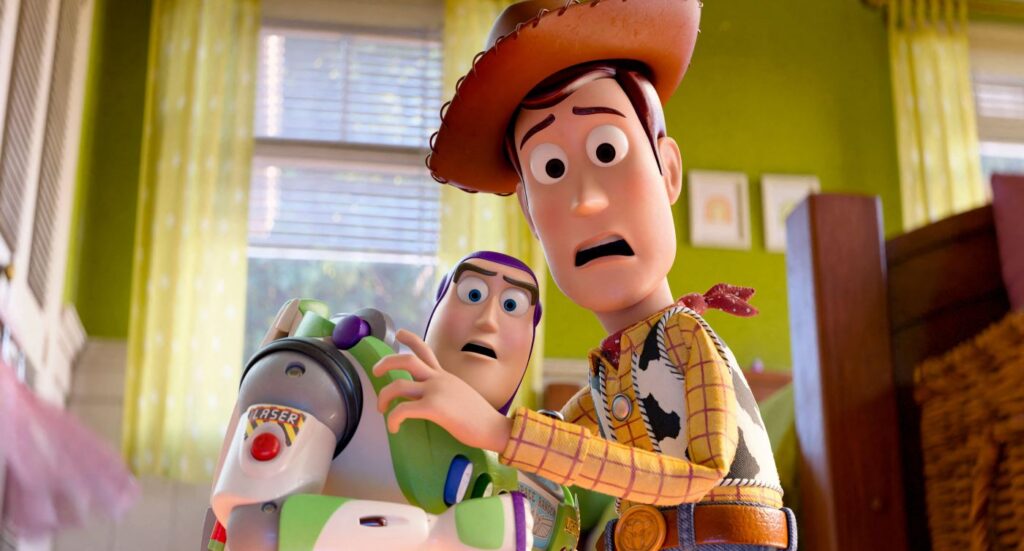
Toy Story is a franchise that shows no signs of slowing down. Its fifth instalment, Toy Story 5, had the all-time second-highest opening weekend for an animated film, grossing $160 million domestically and $152 million internationally. It’s now the third film of 2026 to hit $1 billion dollars and is on track to be the highest-grossing film in the beloved franchise. Rotten Tomatoes Critics gave the film a 94 percent, making Toy Story the best-reviewed franchise in history.
Part of the secret of the films’ successes is how they continue to stay relevant to the concerns of their audiences. Toy Story 3 and 4 dealt with growing up and moving on, as its audience was also doing. Toy Story 5 continues that tradition by addressing parents’ enduring fears of tech and its harmful effects on children.
For a kids’ movie, Toy Story 5’s social analysis is impressively astute. Sometimes it feels like the writers could have read Jonathan Haidt’s Anxious Generation. The film opens with the now eight-year-old only child Bonnie struggling to make friends because all the kids she could play with all have iPads (or, as the film calls them, “Lilypads”). So her parents give her a Lilypad to help her connect with other children. In the film, Lilypad herself is alive like the other toys in the Toy Story universe. And she is motivated to help Bonnie make friends, which she thinks she can do better than Bonnie’s other toys like Buzz and Jessie because all the other kids in the neighborhood are building their friendships online as well rather than playing with toys.
This follows Haidt’s contention that most young people would prefer to be off cell phones and social media, but they can’t because if they do, they will be socially excluded. It’s a collective action problem that requires a collective solution. Early scenes show the doll Jessie looking at all the kids in their homes, not playing with their friends, but staring at screens. Throughout the movie, even when kids or families are hanging out with each other, they’re primarily looking at screens rather than each other. (This leads to one of the best darkly funny jokes in the film, in which the toys run through a house freely and nobody sees them because the whole family in every room is on their devices.)
At the end of Toy Story 5, both Jessie and Lilypad decide that the problem is not toys or tech: it’s that Bonnie doesn’t have real friends, particularly, the right friends who are good for her. So, according to the movie, toys and tech are bad when they keep kids from having the right friends—or match them up with the wrong friends—and they’re good when they facilitate the right friends. Tech, in this sense, can actually be good because it can give you access to a wider group of friends to find the ones that are best for you.
Start your day with Public Discourse
Sign up and get our daily essays sent straight to your inbox.Many of the tech struggles the film depicts actually reflect the real data. Bonnie is portrayed as particularly susceptible to screen addiction because she doesn’t already have friends or a wider in-person community. As author and happiness expert Arthur Brooks notes, non-Western countries are not seeing nearly the same harms from devices that Western countries are. He argues that this is because these groups still have more robust in-person communities than Western countries do, where local community is steadily breaking down. Western social institutions like the family and the church started to collapse long before the advent of smartphones, as Robert Putnam notes in his famous book Bowling Alone.
This also may explain why American conservatives have resisted smartphone-related mental health decline much better than liberals. It is largely because they’ve retained the community benefits of institutions like religion and family. Haidt puts it bluntly: “When kids are rooted in communities, they don’t get washed out to sea by the phone-based childhood.” But Brooks puts it more positively: “If we use the technology to complement our in-person relationships, all the better; if we use it to substitute for in-person relationships, not so good.”
The solution Toy Story 5 proposes is actually what Gen Z has already started doing on its own. The last couple of years have seen a Gen Z-led revival of movie theaters, bookstores, running clubs, churches, and numerous other flesh-and-blood communities and affinity groups. What makes this “return to in-person life” different is that people are using social media to determine their interests and identities, then actively seeking other people like them in the real world.
The problem with Gen Z’s solution, though, is that it’s still using the internet as the starting point for community. People go online, determine their interests, do some Googling, and select the communities to which the algorithm leads them. The virtual world, and the underlying assumptions it feeds (i.e., that they should curate a community based on their unique and individualized interests and preferences), is still the foundation of a social life, and in-person relationships are the superstructure. This is inherently more fragile than community where real-life, incarnational, organically-produced human relationships are the foundation. That’s one reason studies show that, typically, couples who met offline are happier than those that met online.
Churches create a common worship that pulls people together across socioeconomic and ideological differences. This is why sociologist Ryan Burge notes in The Vanishing Church that the church has the best track record of bringing people together. And it is why sociologist Jean Twenge wrote in Generations that social media is one of the biggest drivers of young people away from church. It also contributes to the redefinition of love as agreement that is causing a rise in family estrangement when parents don’t agree with their children on politics, religion, or anything else. That’s one reason Haidt speaks in The Anxious Generation of social media as anti-church: because it is built to cater to increasingly hyper-specified tastes and preferences, pulling them further apart from others who don’t share them.
The problem with Gen Z’s solution is that it’s still using the internet as the starting point for community.
Toy Story 5 treats this gradual fracturing as a feature, not a bug. Lilypad can find the right people for Bonnie that fit her personality specifically. I can see how this is attractive; the internet has led me to many like-minded friends I probably would not have met otherwise. But there’s no acknowledgement that, over time, Lilypad might transform Bonnie into someone who is too individualized to fit with anyone. At the end of the movie, Lilypad and Jessie team up and find the perfect friend who’s exactly like Bonnie and unite the two. It seems, in this happy ending, that Bonnie’s new friend was custom made, made –to order, curated to cater to her hyper-individualized needs, almost like this friend was more AI than human.
There’s something sinister about how Toy Story 5 frames Lilypad. She sincerely wants to give Bonnie friends, and her only mistake is choosing the wrong ones. But in the movie, the greatest harm comes from those human girl bullies, not the tech. Humans are the problem, in this film world. They’re bad; the tech is innocent. But in the real world, tech companies’ priority isn’t to find kids friends: it’s to keep them on the screen as long as possible. That’s how they make money.
There’s also something sadly fitting about how Bonnie is an only child. In the real world, fewer and fewer Americans are having kids, and when they do have them, they’re having fewer. This means the default in-person communities we are born into are becoming smaller and smaller. As economist Catherine Pakaluk recently wrote, “We have a word for children without parents: orphaned. We have a word for those who lose a spouse: widowed. There is no single word in English for growing up without siblings; until now, we’ve rarely needed one.”
We live in a world where we aren’t dropped into a network of families, churches, schools, and local communities that form the basis of our shared lives. We must create these networks on purpose; we have to seek out third spaces where we can meet people with whom to form strong ties. It’s only after we can successfully achieve this that tech will become a healthy part of an already full life, a means of enhancing our human dignity and leading us to flourishing.
Toy Story 5 should be applauded for showcasing both the harms and benefits of screens in a child’s life. But parents should not think their children will be just fine as long as they use technology “the right way.” It will take a stronger real-life community than a purely online one to help children flourish in community with others, to live well with them and alongside them, to know and authentically encounter one another. Then, and only then, will the Lilypads of the world be good for the Bonnies.