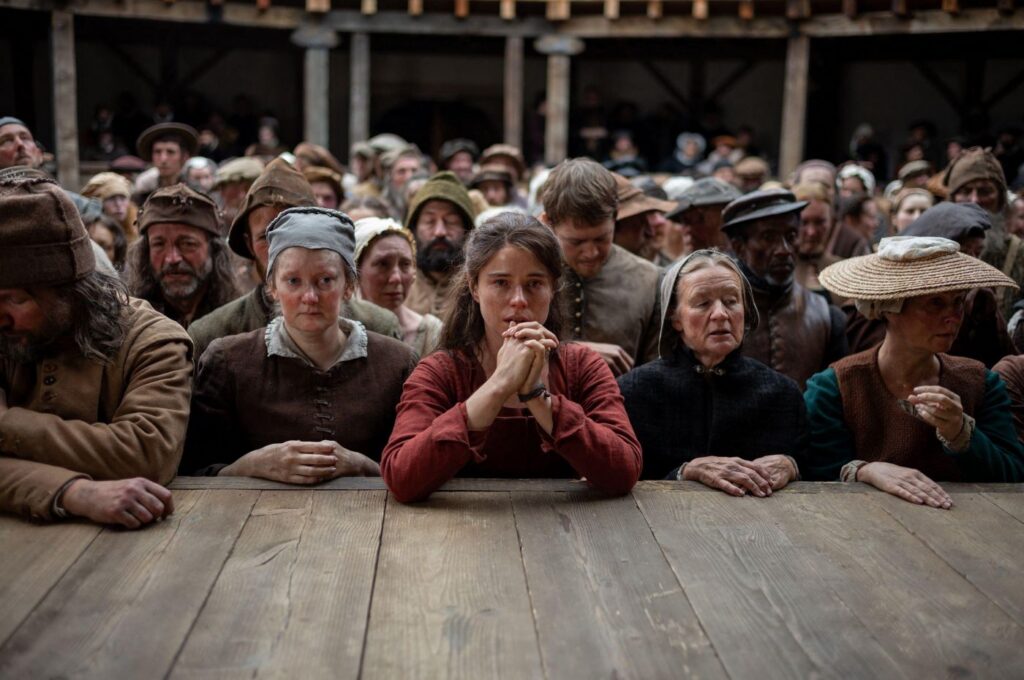
For decades, popular culture has been pushing the idea that each of us, individually, has the right to shape his or her identity. Chloé Zhao’s new film adaptation of Maggie O’Farrell’s bestselling novel Hamnet tells a different story.
O’Farrell’s Hamnet is an imaginative retelling of William Shakespeare’s family life. That is, it’s not really about him, but about his family: his parents and siblings, his wife Anne (Agnes, as she is called in the novel), and his three children: Susanna, Judith, and the titular Hamnet, who dies at only eleven.
In the novel, Shakespeare’s name is not mentioned once. He’s a shadowy character, always travelling between Stratford-upon-Avon and London. He is “father,” “husband,” “son,” “brother,” but never “the Bard.” His artistic success is alluded to, but it’s not in focus.
I don’t think it’s an exaggeration to suggest that, just a few years ago, this story would have failed to capture the zeitgeist in the way that it has managed to do. We’ve been interpreting and reinterpreting Shakespeare’s life and works through the lens of our contemporary sensibilities ever since his death. Poets of the Romantic Era saw reflected in him their own interest in human psychology. During World War II, Laurence Olivier’s Henry V was an explicit attempt at British patriotism in bleak times. Then we get to 1998, with the multi-award-winning Shakespeare in Love, possibly the most ’90s movie to have ever been made: hyperindividualistic, obsessed with self-expression, and excessively reverential toward creative genius. The plot—entirely made up for the film—rests on the premise that the great Bard is short on inspiration, and only an adulterous affair with a beautiful, young, and of course, wealthy woman will fix his writer’s block. Romantic attachment in Shakespeare in Love, despite its title, is ultimately instrumental to creative output.
Self-expression and free choice in constantly reinventing one’s identity were values that were at the forefront of my childhood and young adulthood as an elder Gen Z–er. I remember being halfway through university—the time in one’s life when the search for identity feels most urgent—and being asked by a friend what defined my sense of self. I casually answered, “the people I love and who love me the most.” She was genuinely surprised: “If other people define you,” she pointed out, “aren’t you also giving them the power to hurt you?” I didn’t have a good answer back then, but now I do. Yes, if we define ourselves by our relationships, whether they be familial, romantic, or friendships, we make ourselves vulnerable to suffering. But that’s not a bad thing.
Start your day with Public Discourse
Sign up and get our daily essays sent straight to your inbox.Maggie O’Farrell seems to agree. It’s been a longstanding assumption in literary criticism that Shakespeare must have felt trapped in his marriage, hence his decision to escape Stratford for London. My point is not that this isn’t true—there is evidence pointing both to a happy family life and to an unhappy one, and we will simply never know enough to make a definitive case either way. But I do think it’s very telling that decades of scholarship assumed that it would be impossible for a talented, creative man to feel a strong sense of belonging either to his family or to his local community. O’Farrell refuses to define Shakespeare by his genius. For her, he is first a man, then a husband and father, and only then a playwright.
As Christopher Lasch insightfully points out in his seminal 1997 book Women and the Common Life, premodern society relied heavily on the assumption of mutual aid in the household. Familial and work identities were not so distinct as they are now for most people. The modern home, which “presupposes a radical separation of domestic life from the life of work,” is largely “an invention of the nineteenth century,” argues Lasch.
He’s absolutely right, albeit with a caveat: while this separation fully took place with nineteenth-century industrialization, its seeds had been planted in the early modern period, Shakespeare’s own time. We think of globalization as a recent occurrence, but its beginnings stretch hundreds of centuries ago. Shakespeare’s poetry—and later his plays—wouldn’t have spread so quickly without the relatively new invention of the printing press. Road infrastructure was improved (thus making journeys safer and faster) as a result of increasing merchant trade, especially after European settlement in America. Shakespeare himself was able to travel every few months between the country and the city. In a sense, his work life was a precursor to modern-day commuting. The separation was already taking place.
O’Farrell is highly aware of these sweeping changes. She even imagines that Shakespeare’s son Hamnet might have died because of the plague (the real cause of death is unknown), which had come to England from far away via maritime trade. As John Mullan put it recently for The New Statesman, Hamnet is at least in part a story about “Renaissance globalisation.”
But does this mean that Shakespeare really lived a modern, atomized lifestyle, with no ties to family or local community? O’Farrell doesn’t think so. It’s true that she gives a glimpse into his city life. “He longs … for the four close walls of his lodging,” she writes, “where no one else ever comes, where no one looks for him or speaks to him or bothers him, where there is just a bed, a coffer, a desk. Nowhere else can he escape the noise and life and people around him; nowhere else is he able to let the world recede, the sense of himself dissolve.” Just as millions of young people now in countries like South Korea withdraw into their tiny apartments (a phenomenon known as “hikikomori” in Japan), so O’Farrell shows us a Shakespeare who withdraws into his lodgings to escape the overwhelming daily reality of sixteenth-century London. Society has been in the process of fragmenting for a very long time.
Yet O’Farrell also draws attention to Shakespeare’s enduring rootedness. She imagines him longing for his wife Agnes to move to London with him along with their children: “He will no longer lead this double life, this split existence. … He will be alone no more in the big city: he will have a firmer foothold there, a wife, a family, a house.” Some will be skeptical. Yet, that he continued to return home, even buying land and eventually a house in Stratford, and that he chose to retire there with Anne for the last three years of his life instead of in London, are all well recorded facts.
Indeed, the core setting of Hamnet is not London, but the house where Agnes and William Shakespeare spent the first decade or so of their married life. And the protagonist is not Shakespeare himself, but Agnes. O’Farrell imagines her experience of childbirth, her care in cultivating their herb garden, her profound grief—shared with her husband—at the loss of their eleven-year-old son Hamnet.
Published in 2020, just months into the COVID-19 pandemic, Hamnet benefited from remarkably fortunate timing. Whenever the plague struck in London, all the theaters would be shut down. Shakespeare’s work life would come to a grinding halt, and he would return home to Stratford, where he was still anchored in the local community. Something not dissimilar happened to us six years ago. History repeats itself. Locked inside our houses, many of us started to realize how quickly our jobs and careers can disappear, how empty we feel if we base our sense of identity on our accomplishments. There are certain aspects of our identity that shift—there was a time when Shakespeare wasn’t a writer, and a time after he stopped writing—but others cannot. We never stop being sons and daughters, wives and husbands, mothers and fathers.
That a story that demands we define ourselves by our duties of care to each other should resonate with so many is perhaps a sign that the cultural tide is quietly turning.
Chloé Zhao’s new adaptation of Hamnet fails to translate this idea to the fullest for the screen. It’s visually luscious, and boasts a fantastic performance by Jessie Buckley as Agnes Shakespeare, but it doesn’t trust its audience to have enough media literacy to handle the subtlety of the book; surprisingly so, since O’Farrell herself co-wrote the script. It takes O’Farrell’s emotive but controlled language and turns it into clichés (“Open your heart,” Agnes’s brother Bartholomew tells her in one of my least favorite scenes). As Deborah Ross puts it in her review of the film for The Spectator, Hamnet is “ruthlessly manipulative” in trying to make the audience weep.
But perhaps its gravest mistake is that, as Shakespeare in Love had done in 1998, it fumbles in its attempt to map Shakespeare’s personal life onto his works. Not only is he explicitly named in the film—which defeats the point of showing his identity to be more than the tortured, brilliant genius—but his plays are quoted at key moments of the story. Most egregiously, a scene was added in which Paul Mescal’s Shakespeare (otherwise also brilliant in his role) contemplates suicide by drowning after Hamnet’s death. As he stands on the brink of the river Thames, he begins to spontaneously compose Hamlet’s famous “to be or not to be” speech from the tragedy of that prince. Once again, Shakespeare’s relationship to his loved ones—in this case, his son—is instrumentalized for creative inspiration: the very myth that the book Hamnet tried to dispel.
Yet despite its flaws, I’m glad I watched Hamnet. I’m even more glad that both the film and the novel have been commercially successful. That a story that demands we define ourselves by our duties of care to each other—not by individual success—should resonate with so many is perhaps a sign that the cultural tide is quietly turning. It’s time to remember that, if our interdependence makes us vulnerable, it’s also what gives us a sense of purpose.
Image by Capital Pictures and purchased and licensed via Alamy. Image resized.