Editors’ Note: Public Discourse hosted an essay contest for students in high school, college, and graduate school. Participants were to answer the question: What do you wish your elders knew about the greatest challenge your generation faces? This essay, written by Petra Starkus, receives an honorable mention.
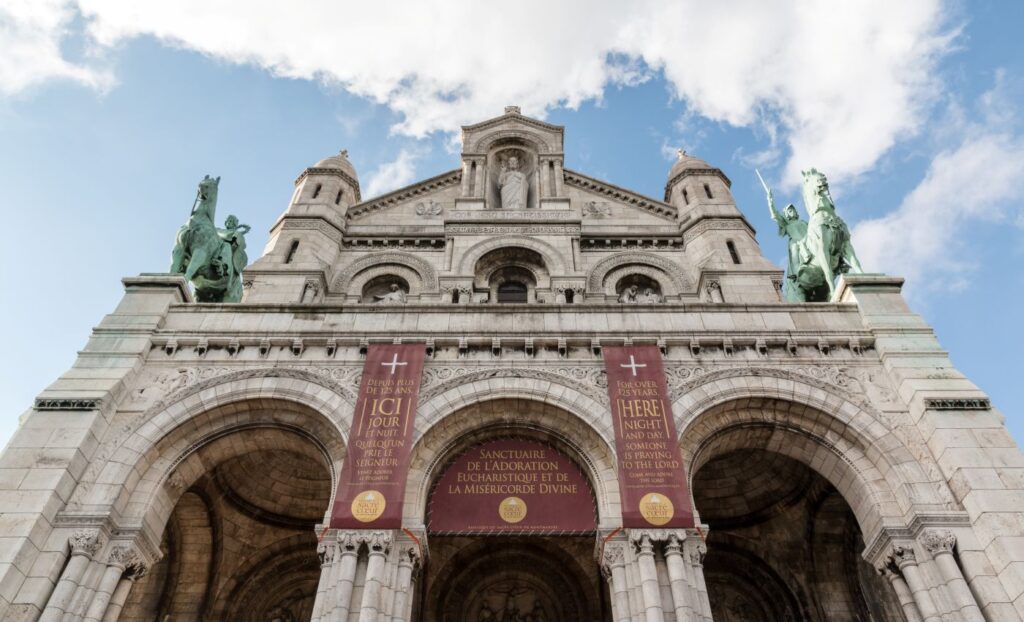
If I were to point to a moment in my life when I developed a consciousness of art, for better or worse, it would be stepping into Sacre Coeur basilica in the Montmartre neighborhood of Paris. To get there, you have to climb a hill of grass disciplined into mere inches of existence and swaths of pigeons. I remember there being a carousel ride at the base, where the street and shops and tourists loitered, just as there is right now and as there has been for the last hundred years. Like a world without end, with melting ice cream cones and languages bubbling off tongues with spit and heat. I wanted to ride the carousel. I watched it go around, transfixed. “After church,” my mom said. Again, “after church. We have carousels at home.” I stumbled up the hill in a mood and by halfway, I was sick of the sweet nostalgic music following us from the ever-rotating menagerie. Weak and tremulous, we lost it somewhere after the 199th troupe of pigeons.
But suddenly the daylight vanished and the sky was replaced by cavernous limits, a cold and dark marble. Then frontward, like a setting sun, was the immense pale visage of Christ. Just as the setting sun has all the rarified glory of day and more, inflamed and condensed at once before it is swept from the earth, so did he. There were smaller figures and designs around, a pope, a virgin, an angel, and like clouds they were tinged with his hue. But all I could see was him, and I felt he was there in the flesh before me. My little mind had been filled just before with every bit of childhood gratification, of ice cream and carousels and music. But now I was entirely vacated but for one feeling: sorrow. I felt sorrowful before the new face but the familiar man, sorrowful before his furrowed brow, his gentle eyes. He wore white. His hands were punctured and his feet as well, and with his face, they bothered me. Again he was the sun, and like someone staring too long, I was burnt by the sight.
In retrospect, it hurt because I was sorry. Sorry for never seeing him like I did then. Sorry for never bothering to hold him in view and invite him into my eyes and my mind. Nor would that be the last time I would undergo the same cycle: pain and beauty and sorrow like phases of the moon, all in however long I sit it out before his face. But when I leave the presence of the art, the feelings diminish. So it was not just a consciousness of art that developed in me that afternoon in Montmartre but a consciousness of God as well, so that the two became inextricably combined. For a long time, I rarely appreciated art unless it drove deeper than this world, and tried to capture something of the other. It also went the other way: what was my faith without those feelings and the art to capture my heart in like a net?
Recently, though, the relationship between man and creativity has changed radically, in a way it has not in all the millennia of human history, throwing my own personal dynamic with art into confusion. Art has forever been in flux: from Grecian urns to medieval poetry to my sad Christ, laid down as a mosaic in the late nineteenth century. Yet the fundamentals seemed eternal. Art has always been made by men and always viewed by men. Art demands skill and time and effort and all of those demand, perhaps, a sort of love. Regardless, many people who were not artists have disagreed about the definition of art for years. According to Aristotle, art is an imitation of reality and it reveals the inner truths about it. Other philosophers have disputed this, as well as the role of beauty, but the dialogue has largely been consistent. Even if men are too stupid or indisposed to grasp precisely the definition of art, it has still always been there, making some things beautiful and worthy of attention and others not.
Start your day with Public Discourse
Sign up and get our daily essays sent straight to your inbox.But in the strange new era in which we live, one that was already burgeoning to life when I first had my timeless experience at Sacre Coeur, it is possible to type in a few words into a chat box and produce any content one desires. A year ago, I had hardly heard of ChatGPT. It was one of those things like a war overseas or a cousin that has a baby that holds only a vague and tangential spot in your mind. Later when it feels relevant, you go searching for it, finding some reference someone made that is hardly even in your memory’s grasp. I recently went searching, and realized my uncle has been mentioning this for years. A tech-literate stockbroker, Uncle Jack has told me since I was in middle school not to go into jobs I am in danger of losing to AI, besides all his other theories about flying cars and genome editing. But in ninth grade we had to write one of our English essays in class, because of some mystical creature called ChatGPT. From then on I despised its very name. It is infuriating to struggle over your pen like a plow and the paper like a barren field, only for someone or something to write it much better with much less effort. What is the point of writing then? In the context of school, it is to get the grade and be done with it. That is how I have sourced the motivation for writing the last two years.
In the strange new era in which we live, one that was already burgeoning to life when I first had my timeless experience at Sacre Coeur, it is possible to type in a few words into a chat box and produce any content one desires.
But I still had never visited ChatGPT’s website or experienced it first hand. Not until a few months ago, when I started thinking about a psychology project I could do, mostly for fun but also so I could tell people what I was up to during the summer. I landed on an idea while reading Hamlet for literature class. In the play Hamlet uses art in a fascinating psychological way: in order to reveal his uncle’s culpability in the murder of his father, the king, Hamlet stages a play in which a very similar plot unfolds. Then, his plan is to carefully watch his uncle’s demeanor, and see his agitation leak from his skin like a casing over his inviscid soul. Art implicates us in the great scheme of reality, by revealing the deep and hidden truth, whether we want it to or not. Art revealed to me my horrible disregard for the Lord, and a longing for him I did not even know that I had. Another thought I stumbled upon in those days of project-making was Victor Frankl’s logotherapy. A treatment for anxiety and depression, the underlying theory of logotherapy posits that man is not motivated by desires or by power but by meaning (in contrast to Freud and Nietzsche respectively). Man’s source of meaning defines him, and the quality of his life. With these two ideas within me, I wrote out a list of questions for my family in order to identify what they find beautiful and what they find meaningful. I wanted to know if they approach art the same way, if they could see their own sense of meaning in an artwork and how that artwork would make them feel. But I ran into a problem: What would the last part look like practically, should I make a lot of art, stories and poems and pictures, or use what has already been made? I doubted my skill and my time management ability to be able to produce anything good but picking art already created sounded just as complicated as well as not personalized enough for my purposes. Then I thought of it: ask ChatGPT to create for me exactly the art I want. I would be able to copy and paste specific details from my family’s answers to the questions into the ChatGPT chat box and produce something much better than I could ever create. Perhaps even better than what artists have already created. but picking art already created sounded just as complicated as well as not personalized enough for my purposes. Then I thought of it: ask ChatGPT to create for me exactly the art I want. I would be able to copy and paste specific details from my family’s answers to the questions into the ChatGPT chat box and produce something much better than I could ever create. Perhaps even better than what artists have already created.
I tested it out, giving the computer detailed descriptions of exactly what I wanted to see. Every time it nearly produced it, though the more complex the description, the less loyal it was to its instructions. Once I asked it to draw me a picture of my boyfriend holding a piece of corn he told me had taken from his grandparents farm to remember them by. I said his age and the color of his hair and eyes and asked it to draw it in the style of Grant Wood’s American Gothic. The results made me pause: the resemblance between the real boy and this one was striking, despite the lack of detail, and even more strikingly, ChatGPT had understood enough from background information, to make his expression somewhat sad, somewhat contemplative. Unlike the figures in the original American Gothic painting, his eyes are downcast but not especially emotional, his mouth slack. I was amazed with my newfound powers. The one aspect where I felt the computer had failed was that this piece did not look like it had been created. ChatGPT struggled to mimic all the roughness and imperfections that are characteristic of reality, and the smallest details looked forced and flat. But this image hadn’t been created; rather AI simply presented me an amalgamation of all preexisting creation.
I put the computer away. To use ChatGPT in my thought child of an experiment seemed disrespectful to the muse who had inspired me with the idea. It seemed negligent of the little pieces of soul I had gathered. It seemed this wholly empty and utilitarian device would pollute the rich humanity I wanted to capture, and thus throw the results. It would be a threat to the experiment’s validity, and would make all my efforts go to waste.
But nor is it the case that genuine art is on demand, or has ever been. Time is an indelible factor, such that it eradicates my summer plans and college applications. Now I no longer have a cool study to brag about. But I do have the confidence that men will be able to make art in the future, and that gives me comfort. It’s a fact that the genealogy of a thing is as important to the viewer as the thing itself. We do not separate the art from the artist, and it matters to us if our slippers were handmade by a shepherd in Nepal. At least if we are trying to view the thing as more than its use, it matters to us. Art is useless, and perhaps that is why it’s meaningful. Perhaps that is why I need someone inefficient and imperfect to take my Google doc, gathering its virtual dust, and produce something inefficient and imperfect. Because for whatever meaning is, it cannot be artificial. That is eternal.
Image from Wikimedia Commons and used according to the Free Art License. Image resized.