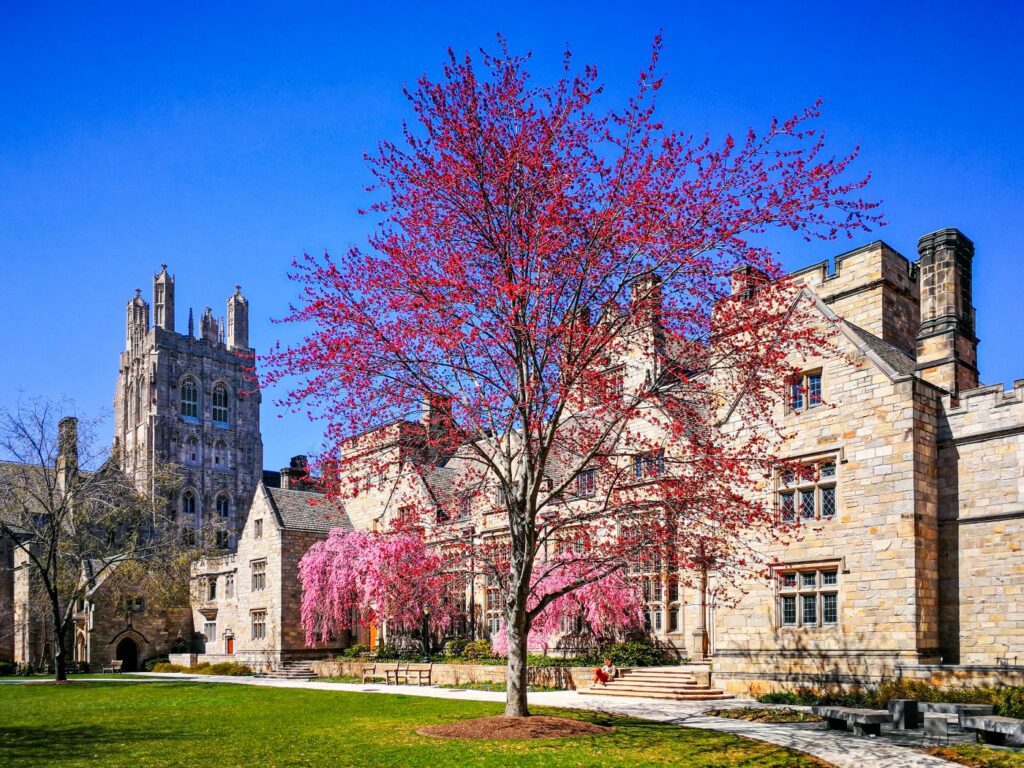
The late conservative icon William F. Buckley released God and Man at Yale in 1951, at age twenty-four. This polemic, released as Yale turned 250 years old, wielded the unique knowledge of a recent graduate to contend that that the Yale faculty were actively inculcating students in secularism while dismissing religion as “superstition”; that this malfeasance went far beyond mere open-mindedness (and that it would be undermining even if relativism were its end); and that Yale faculty were simultaneously indoctrinating students in an anti-capitalist economic ideology that threatened America’s system of limited government while instigating admiration for collectivism and ultimately, socialism.
By the time I was enrolled as an undergraduate at the University of Pennsylvania in the 2000s, the notion that the “tenured radicals” comprising an ivy league faculty would so much as pretend to conceal their investment in secular orthodoxy—or profess anything other than collectivist economics (which they, of course, do not practice)—seemed implausible on its face.
By then, the venal bargain that Tyler Austin Harper lambastes in his recent essay in The Atlantic had long since been made, albeit in a less extreme form: influential faculty in the humanities and social sciences “discover” and “study” wild theories about race, sex, and gender—the crazier and more inexplicable to normal people the better—all while ratcheting up student debt and outsourcing ever more teaching to poorly paid adjunct instructors without benefits.
Yet meanwhile—at least during my time at Penn—most of the students, even the ones majoring in the humanities, intended to go into business or some other lucrative field anyway. The real goal was not self-sacrificial do-gooding or a restructuring of society to better serve the poor, but fluency in an esoteric, elite language in which to express the most sophisticated brand of virtue-signaling available.
Back then, the “Not Penn State” shirts notwithstanding (full disclosure: I went to Penn State for graduate school), the prospects and ambitions of most Ivy League “true elite” were really just a punched-up version of those of the so-called “state school upper-middle-class.” Buckley’s era of a true aristocracy was long past; fitful meritocracy had long been the order of things. This narrowed the gap between college grads from different kinds of schools. So, sure, the degreed “normies” might have had, on average, worse taste and fewer pretensions (yes, these things can coexist) than their more elite-degreed counterparts. Nevertheless, until several years after I graduated, the Ivies popularly retained their universal credibility, their aspirational mystique, and their mainstream currency—despite all that Buckley lamented sixty years before having come to pass (and then some).
Start your day with Public Discourse
Sign up and get our daily essays sent straight to your inbox.Why has it taken three quarters of a century for these storied institutions to suffer any real damage to their reputations despite producing and lionizing people and ideas that are out of touch with so much of the American public for so long? And what will happen to American higher education writ large going forward, now that its leading lights have finally dimmed in the eyes of the public?
I don’t have any real answers. Still, having spent nearly twenty years in four different universities (one Ivy League, two state-related, and one Catholic) in a variety of roles (undergraduate student, master’s student, adjunct faculty, faculty member, doctoral student, and staff member), I feel prepared to make some educated guesses.
Goodbye, God
Barack Obama’s 2000s political rise was built on a compelling lie: America can and will overcome not just racism and tribalism (worthy goals to be sure), but all manifestations of so-called “intolerance” rooted in worldviews that simply do not accord with liberal secularism. So long as it seemed like the march of forward progress would continue unimpeded—as it did during my undergraduate years—elite universities could and did put on a show of “platforming” conservatives, in sporting fashion.
In part, this was because the regnant form of conservatism all the way through the 2000s was shaped in many ways by Buckley’s eloquence, capaciousness, and charm—and his stern marginalization of racists and maniacs from respectable discourse. The harsh or even “offensive” words of even the most “extreme” conservatives with major positions or platforms were then tempered by what would be, by today’s standards, exceptionally cordial manners. This was as true of George W. Bush as it was of Buckley. Indeed, Bush’s friendship with Obama comes from a more genteel, less honest world that now seems quaint; yet, it was one that still existed in the Ivy League schools that both attended.
Personally, I functioned as the token conservative in dozens of humanities classrooms, as both an undergraduate and as a doctoral student. People mostly treated me just fine. Yes, there were times when I was self-conscious of seeming a little unsophisticated. Imagine, for example, contextualizing Uncle Tom’s Cabin by offering information about the Fugitive Slave Act rather than via the anachronistic “lens” of twentieth-century queer theory (just one faux pas of which I was guilty).
But overall, I lent the intellectual monoculture in my classes some friction, and everyone sort of appreciated having around a person or two who could spar well enough to make them feel like they were in less of a completely out of touch bubble. That, of course, was nonsense: I’m not really a conservative, nor would I pass for one among people who are. But, by virtue of being at all religious and reasonably sane, I sure seemed like one to my professors and classmates. Which underscores my point: the fact that campuses before 2013 or so were not openly hostile to me (after about 2013, I mostly kept my mouth shut) does not prove Buckley wrong, but underlines just how right he was.
It was not until 2014 or so, when most college kids first had smart phones and social media, that any pursuit of truth—godly or otherwise—became truly anathema in institutions of so-called higher learning. Unsurprisingly, the most elite institutions went first and furthest down the rabbit hole of fetishized fragility. Indeed, that infamous mass tantrum over the mere prospect of “offensive” Halloween costumes (often pinpointed as the moment when normal people became wary of elite universities and their influence on both their students and the wider culture) occurred, predictably enough, at Yale.
In the years between 1951 and 2015, Buckley’s prophetic arguments had gone unheeded even as they were paid lip service. But it took the social-media-induced demise of any common culture to unleash an elite, university-based left without so much as any pretense to true tolerance.
And, of course, the 2016 election of Donald Trump provided a retrospective excuse for the fervent insularity that ensued—eventually resulting in multiple Ivy League presidents too afraid of their own faculty and students to condemn actual violence against Jewish students.
Perhaps this is what Buckley meant when he argued that relativism never ends there. It is not a question of whether values beyond mere “values pluralism” will be lionized, but which ones will.
Thus, in a postmodern and increasingly siloed society that now lacks any universal moral codes or even reference points, it isn’t clear that the value of humanity itself can be successfully defended—at Yale or anywhere else.
Farewell, Man
Having thoroughly marginalized God, today’s universities are contending with two foreseeable repercussions of man’s impending marginalization. First, there is a birth-dearth-driven population decline that leaves once financially secure institutions worried about keeping the lights on. Second, there is AI.
The number of prospective college students in America has been in decline for well over a decade now, ever since the peak of my millennial cohort passed through our college years. Universities mostly have not responded to the shrinking pool of prospective students, functioning with the same or more administrative overhead and declining to cut failing programs until it is too late. For many years, a combination of falling standards and international students obscured this reality. Now, both of those stopgaps, themselves, are falling apart.
The admissions standards at non-elite, non-flagship schools cannot go any lower, because “complete application” has been pretty much the whole of it for a while. Meanwhile, restrictive immigration policies and resultant international tensions have reduced the pool of foreign students who used to balance university budgets.
And, at the same time, the steady ascent of AI presents universities—elite ones, first and foremost—with a fork in the road. They can resist becoming places where smart students avoid learning anything by way of AI-completed assignments and papers. Or they can capitulate in an attempt to remain “cool” in the eyes of a bunch of twenty-year-olds who know nothing. With no moral or intellectual center to draw on for more than seventy-five years now, of course, they will mostly succumb to the times.
Harvard (Harvard!) has recently eliminated its writing center. All fancy, self-justifying rhetoric aside, the obvious reason why is that students no longer write their own papers; so, what need do they have for writing instruction?
The notion that modern universities will educate anyone in the sense that Buckley conceived of education is dead. The universities wrote that eulogy themselves, and long before AI could do it for them.
This, too, goes back to Buckley. In his era, elite university faculty were unwilling to acknowledge or accept the existence of truth. By mine, even less elite university faculty had turned on the truth of simple grammar. When I worked in the writing centers of that era, we tutors were instructed not to write on students’ papers lest we impinge on their own voices by correcting their grammar or syntax. So, this was talk therapy for writing rather than writing instruction. It’s easy to see the slide from there to broad acceptance of AI-generated papers. After all, the faculty—always enamored of the inevitable coolness of whatever is new—wouldn’t want to interfere in today’s creative process. And thus, they make a solid case for their own obsolescence.
That said, the truly elite universities, whether Ivies like Yale, Harvard, and Penn, or “might as well be Ivies” like Notre Dame, Stanford, and Duke, are not going anywhere. (Many smaller, private colleges—including some elite ones—will not be so lucky). Meanwhile, the big state flagship schools and their lesser knock-offs—where “normie” smart kids prepare for careers that pay enough to live upper-middle-class lives—will be the big winners of the higher education shake up (as they should be).
If COVID and the online education revolution proved anything, it is that Americans are beyond attached to these places, and in ways that surpass the merely professionally instrumental. Nevertheless, the notion that modern universities will educate anyone in the sense that Buckley conceived of education—or that the American public should have any preemptive respect for professors’ perspective on anything—is dead.
The universities wrote that eulogy themselves, and long before AI could do it for them.