In his first encyclical, Pope Leo XIV writes: “When subsidiarity is not linked to solidarity, it ends up becoming merely the protection of particular interests; when solidarity is not supported by subsidiarity, it degenerates into a form of welfare that does not foster responsibility.” The principle of subsidiarity insists that higher authorities exist to assist, not absorb, the lower associations of family, parish, township, and state. Solidarity, its necessary counterpart, requires that those same lower associations never forget their obligation to the common good.
With the size of today’s federal bureaucracy, it seems hard to believe that the United States government was ever an example of this link, this harmony between subsidiarity and solidarity. Yet this was the opinion of Orestes Brownson, the nineteenth-century intellectual and Catholic convert, as he reflected on the Constitution at the close of the Civil War. Looking to his thought to regain this balance would be helpful to those who, holding to natural law and the common good, seek a way forward for our divided nation.
The balance was not achieved easily. As the debates on the ratification of the U.S. Constitution raged in the state legislatures, an overwhelming concern was precisely this balance between solidarity and subsidiarity. Many believed that the document produced by the Constitutional Convention vested too much power in the national government at the expense of the sovereign states.
With the addition of the Bill of Rights, a supermajority of Americans agreed that the new form of government adequately protected the citizens from centralization, providing an acceptable balance between subsidiarity and solidarity. One of George Washington’s greatest achievements was to maintain this balance throughout his presidency in the face of the subsidiarity faction led by Thomas Jefferson and the solidarity of people in the North, particularly Alexander Hamilton and John Adams.
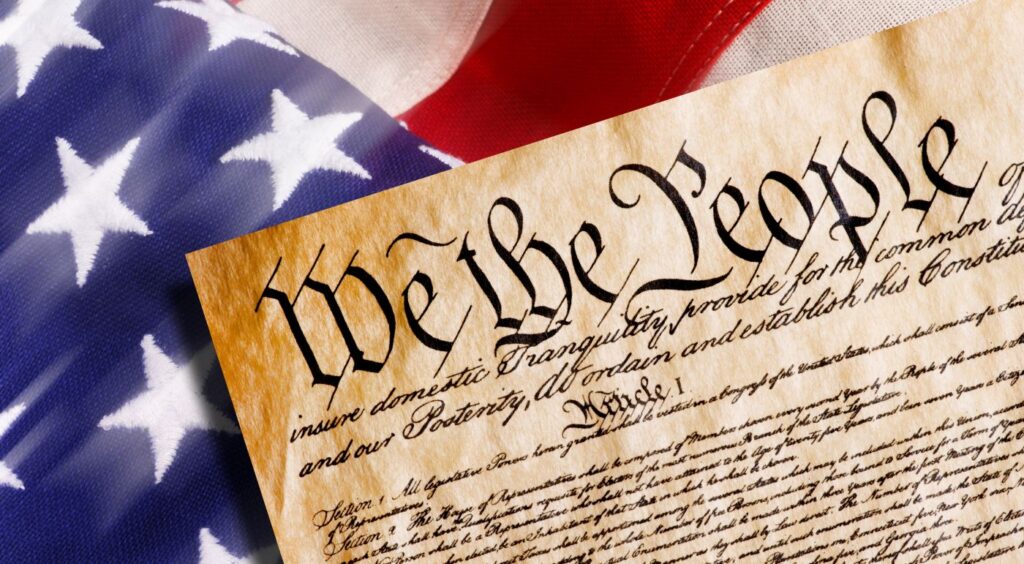
The Providential Constitution
Start your day with Public Discourse
Sign up and get our daily essays sent straight to your inbox.In The American Republic, his 1865 masterwork, Brownson challenged Americans to confront the deeper truths of our nationality:
Among nations, no one has more need of full knowledge of itself than the United States, and no one has hitherto had less. It has hardly had a distinct consciousness of its own national existence, and has lived the irreflective life of the child, with no severe trial, till the recent rebellion, to throw it back on itself and compel it to reflect on its own constitution, its own separate existence, individuality, tendencies, and end.
The nation’s having survived the ordeals of its birth and infancy and, more recently, a great internal conflict, Brownson contended that the “distinct consciousness of [our] own national existence” is that our form of government is providential. It was providential in its origin, being the confluence of flight from religious persecution, English common law, prior experience of self-government, and so many other factors. It was also providential in its call to responsibility and virtue. Madison’s “balance of competing interests” is based on the reality of original sin and the wounded nature of mankind, but there is another reality; Jesus has redeemed man and calls us to share in the divine nature. Brownson sees the Constitution as a call to give glory to God through the self-sacrifice required in serving the common good.
Furthermore, it is providential in its structure, based on universal principles linking solidarity and subsidiary. Brownson argued that the “real character” of the Constitution secures national unity without consolidation by asserting the authority of society (solidarity) while preserving the rights of the several states without disintegration by protecting individual freedom and local governance (subsidiarity). Using the terms “personal democracy” and “humanitarian democracy,” Brownson was praising what Pope Leo XIV now calls the “link” that alone prevents both egoism and bureaucratic paternalism.
All of this led Brownson to conclude that the Constitution was providential in its composition. God was the primary cause of both the unwritten and written constitutions, with the founders acting as secondary causes, creating a sacred framework for ordered liberty.
The Civil War: The Collision of Subsidiarity and Solidarity
Brownson argued that the American Civil War was caused by “equally destructive exaggerations” of two fundamental truths—solidarity and subsidiarity—that the Constitution was designed to harmonize. This fact, which had eluded the attention of historians and political commentators, is accomplished by its territorial character: what we today refer to as federalism, the diffusion of power to the states and local communities. This was the only way to recognize “place, tradition, religion and family in the various states,” and to accommodate the vast differences in “the sentiments, convictions, and habits of a local people” due to their geography, natural resources, and local economies.
Brownson held that it was this territorial democracy, the preservation of the true Constitution, that was at stake in the Civil War. Americans in the North had for the most part fought to preserve the Union, not to impose the northern ideology of humanitarian democracy in the form of abolitionism. In Brownson’s words:
[T]he great body of the people in the non-slaveholding States, wedded to American democracy as they were, and are, could never, as much as they detested slavery, be induced to make common cause with the abolitionists …The great body of the loyal people instinctively felt that pure socialism is as incompatible with American democracy as pure individualism.
Personal democracy divorces itself from a broader social responsibility. This purely individualistic strain of democracy was promoted by the followers of John Locke, who denied society’s obligation to protect the weak and helpless. The logical consequence is anarchy as each individual or special interest group pursues its private interest and loses sight of any common good.
In the 1850s, Brownson supported the southern states’ efforts to protect themselves from the excesses of federal power but, as the calls for secession became louder, he increasingly warned that the concept of state sovereignty was being taken to an extreme that ignored the higher value of national unity and would remove the necessary counterweight to humanitarian democracy. This would negate the “Divine Idea” behind the Constitution.
On the other hand, Brownson spent the first half of his life in New England, the womb of humanitarian democracy, which he described as “a menace to our future” and whose nature is “to mind every one’s business but its own.” He criticized any movement, such as abolitionism or temperance, which “scorns all geographical lines, effaces all individualities, and professes to plant itself on humanity alone.” Such a movement would attempt to protect the vulnerable by using centralized federal power to forcefully overturn local laws.
The humanitarians are more dangerous in principle than the egoists, for they have the appearance of building on a broader and deeper foundation, of being more Christian, more philosophic, more generous and philanthropic; but Satan is never more successful than under the guise of an angel of light.
Brownson’s sober assessment at the end of the Civil War was, “If the victory of the Union should turn out to be a victory for the humanitarian democracy, the civilized world will have no reason to applaud it.”
Brownson advocated for a “long-term, multi-pronged rediscovery of the true Constitution,” an ordered liberty founded on a balance of unity in diversity based on natural law and the pursuit of the common good. He challenges us to “rediscover the true Constitution.” Now would be an appropriate time to follow his advice.
Solidarity and Subsidiarity Out of Balance
In his annual message to Congress in December 1862, President Lincoln proposed a gradual elimination of slavery with federal compensation to the slave owners. Brownson disagreed with Lincoln on particulars but also promoted a gradual incorporation of the freed slaves into the body politic. But calls for gradualism were ignored.
With the war’s conclusion, the North had defeated the South and humanitarian democracy was intent on refashioning southern culture’s Reconstruction. The immediate release of the slaves without compensation embittered the white population of the South which violently turned on the black population, resulting in the Fourteenth Amendment. As necessary as it might have been given the circumstances, Brownson was concerned that it represented a revolutionary transfer of power from the states to the federal government in which each state lost the right to define its political people and freely exercise its own character.
Throughout the twentieth century, this move to redefine America by disturbing the delicate balance of solidarity and subsidiarity was ratified by the Supreme Court by incorporating the Bill of Rights into the due process clause of the Fourteenth Amendment. The same expansive reading of due process has since nationalized controversies—from public education curricula to emergency health measures—that the original Constitution left to the varying judgment of the states.
The reader need not be reminded of the recent triumph of solidarity over subsidiarity when the due process clause of the Fourteenth Amendment was invoked to establish same-sex marriage as the law of the land in the case of Obergefell v. Hodges.
We the People, that is, two-thirds of both houses of Congress and three-quarters of all state legislatures, continued the erosion of subsidiarity with the Fifteenth, Sixteenth, Seventeenth, Nineteenth, Twenty-Fourth, and Twenty-Sixth amendments. Of these, the most significant might be the Sixteenth, granting the federal government the right to tax income and fund the administrative state, the unelected experts and bureaucrats that keep it operating and the myriad regulations that so complicate our lives and mock the very concept of subsidiarity.
Congress habitually supports solidarity at the expense of subsidiarity when it abdicates its constitutional responsibilities to the executive branch spawning innumerable three-letter agencies. Both political parties are guilty of this; both parties blame the other for doing it when it behooves them, and both parties continue doing it.
In 1873, Brownson lamented in his journal, Brownson’s Quarterly Review, “I cannot conceive a more profoundly philosophic, or more admirably devised constitution, than that of our own government.” Yet “the people have forgotten its providential origin, treat it as their own creation, as a thing they have made, and may alter or unmake at their pleasure.” They perceive any violation of the Constitution as “no moral offense, for it is the violation of no moral law, of no eternal and immutable right. Nothing hinders the people, when they find the constitution in the way of some favorite project on which they are bent, from trampling it under their feet, and passing on as if it never had any existence.”
Restoring the Providential Balance
Brownson’s insistence that the “true Constitution” was providential—a gift of God for all humanity—brings us back to Pope Leo’s concern. A century and a half ago, Brownson held that our Constitution was a fully negotiated balance between solidarity and subsidiarity; a balance that has been lost. Today’s political discussions, pitting one faction against the other, and the politicians that it engenders are incapable of restoring the link, the balance, between solidarity and subsidiarity that Pope Leo regards as essential for every society.
Solidarity and subsidiarity will only be linked by those willing to sacrifice their own opinions to uphold universal principles and the common good; incomprehensible concepts for those imbued, on the left and on the right, with the individualism of Enlightenment thinking. Therefore, before political action, there must be a total recasting of our thinking on government. The renewed emphasis on civics education will be fruitless if it only regurgitates Locke and Kant. The “originalism” we must seek is not the ideas of the founders but the Divine Idea behind the founding itself.
It is hard to identify any living American who compares to the profundity of Brownson’s thought. He alone shows us the goal, the path forward, and that path is a return to a constitution similar to the one he found so “admirably devised.” We the People need the resolve to proceed step by step, along the “long march through the institutions” with the generosity of the founders, knowing that what we do today will only be enjoyed by future generations.
In his day, Brownson advocated for a “long-term, multi-pronged rediscovery of the true Constitution,” an ordered liberty founded on a balance of unity in diversity based on natural law and the pursuit of the common good. He challenges us to “rediscover the true Constitution.” These years leading up to its 250th anniversary would be an appropriate time to follow his advice.