In its “Institutional Statement Supporting the Choice for Life,” the University of Notre Dame states that, in accordance with the magisterial teachings of the Catholic Church, it “recognizes and upholds the sanctity of human life from conception to natural death.”
But the recent appointment of Professor Susan Ostermann—whose public and explicit pro-abortion advocacy is well-documented—to direct the Liu Institute for Asia and Asian Studies has drawn sharp criticism from many quarters of the Catholic community, including Notre Dame students and faculty, prominent leaders of the pro-life community in the United States, and a number of Catholic bishops across the country. In response to these criticisms, the university reiterated that Notre Dame’s institutional position on the sanctity of life remained “unwavering.”
Though Professor Ostermann has ultimately elected to decline the appointment in light of these critiques, broader questions remain about the nature of institutions of higher learning with clearly established religious missions. What, for instance, does it mean, in practice, to hold an “institutional” position?
An institution (institutio + “statuere”) is a thing established, set up, and built on the stable foundation of its traditions: in the case of Notre Dame, the foundations and traditions are Catholicism, the Holy Cross charism, and the conviction of its founders that Our Lady’s University is a “powerful means of doing good.” There should ideally be a coherence between these institutional foundations and the arrangement of the institution’s component parts. The contested question that this current controversy has raised—whether an individual faculty member who has publicly and explicitly expressed views that are by all accounts contrary to bedrock Catholic commitments about the sanctity of life should be promoted to a visible position of administrative leadership—is in fact enfolded into a larger philosophical and theological debate about the nature of Catholic institutions. It also has raised questions about Catholic education and whether, at the end of the day, it will insist on the holism and radical integration that the Catholic tradition seems to require.
The late Alasdair MacIntyre—the de Nicola Center’s Permanent Senior Distinguished Research Fellow until his death last May—wrote Three Rival Versions of Moral Enquiry, in which he considers the state of the modern research university precisely as an institution. Chapter 10, on “Reconceiving the University as an Institution,” notes that contemporary iterations of academic institutions are marked neither by holistic coherence nor by “morally committed modes of dialectical enquiry,” but rather by a “divisive and fragmented partitioning” where often the left hand knows not what the right hand is doing. Because the modern university so conceived does not share any clear agreement on what constitutes rational inquiry, it will simply tolerate “limitless disagreement.” In circumstances that bring moral or theological claims decisively to the fore, however, there are foundational points that “by their very nature cannot accept the indifference presupposed by such tolerance, standpoints which invite rejection rather than toleration” (emphasis mine).
Start your day with Public Discourse
Sign up and get our daily essays sent straight to your inbox.According to MacIntyre, when the (only purported) neutrality of liberalism’s rationalized discourses collides unceremoniously with a bedrock disagreement of morality or theology, “the liberal university can provide no remedy.” Robust moral and theological claims—like an unwavering institutional commitment to the sanctity of all life, from conception to natural death—are thus the shoals on which the tolerant discourses of the modern university will inevitably crash. It is no wonder, then, given the larger and systemic incoherence of the modern liberal university that MacIntyre details, that institutions like Notre Dame can often find themselves embroiled in these sorts of conflicts.
The University of Notre Dame, however, does not and ought not have the luxury of relegating moral and theological questions to the margins. We do not and ought not have the luxury of exempting ourselves from substantive moral and theological conversations. We are the place where, as Fr. Theodore Hesburgh put it so memorably, “the Church does its thinking.”
Given recent events, it is our duty and obligation to recenter and rearticulate the strongest possible moral and theological claims that undergird Notre Dame’s “unwavering” institutional commitment to life. It should first go without saying that to be institutionally pro-life is to be consonant with the fullness of Catholic social teaching. Pope St. John Paul II’s encyclical Evangelium Vitae is clear that building a culture of life attends both to the “unspeakable crime” of abortion, and to any situation and circumstance in which life and the dignity of life are threatened or diminished from conception to natural death. Such situations and circumstances would include the whole sad litany of a culture of death: euthanasia of the sick, the dying, the disabled, and the elderly; assisted suicide; artificial reproductive technologies; poverty; declining birthrates; unjust wars; the death penalty; racism; maltreatment of refugees and migrants; lack of good maternal and infant care; broken families; and so on. The Catholic commitment to the inviolability of life, from its reading of the Hebrew Scriptures to its reading of the present moment, requires the protection and defense of life wherever it is “weak and threatened: in the case of foreigners, widows, orphans, the sick and the poor in general, including children in the womb.”
It is manifestly true that Our Lady’s University—an institution that I love dearly and in which I have invested the last twenty-one years of my personal, professional, and spiritual life—affirms and upholds in many concrete and joyful ways the dignity of all human life, born and unborn, from conception to natural death. I can speak best to my own historically situated context in the de Nicola Center for Ethics and Culture, which I have had the good fortune of directing since July 2024. The dCEC serves as a prominent and energetic locus for advancing Notre Dame’s institutional commitment to pro-life teaching, research, and engagement, both on campus and as the voice of Notre Dame in the global public square. We administer Notre Dame’s Evangelium Vitae Medal, the nation’s preeminent lifetime achievement award for individuals whose efforts have significantly advanced a culture of life around the world, typically with the university president, the local bishop, and many hundreds of faculty, staff, and students in attendance. The de Nicola Center also offers the annual Notre Dame Vita Institute, an intensive intellectual formation program for senior and emerging leaders working to build a culture of life around the globe.
We do not and ought not have the luxury of exempting ourselves from substantive moral and theological conversations.
In addition to sponsoring the university’s annual participation in the March for Life, the Center also provides resources for the Notre Dame Right to Life Club (the university’s largest student group). This past year, as part of our Women and Children First Initiative, the Center facilitated an academic and pastoral conference for parents, caregivers, and professionals facing difficult life-limiting prenatal diagnoses. Through its efforts to build a culture of life, the de Nicola Center (alongside such partners as the McGrath Institute’s Office of Life and Human Dignity and the University Faculty for Life) brings Notre Dame’s voice to the forefront of the national and international conversation on human dignity.
Articulating and sustaining a genuinely holistic pro-life position as an institution, however, requires something else of Notre Dame that is both far more radical and more difficult. To be “holistic” in anything, of course, is not only to consider the full panoply of all the parts of complex problems and their complex solutions, but also to consider how those parts relate one to another and to the whole. To be holistically and institutionally pro-life is therefore not simply a matter of addition—of working, for instance, to address not only the scourge of abortion but also euthanasia, assisted suicide, or any other affronts against human dignity, or of extending care and support not only to the unborn child but also his or her mother. Holism for the Catholic institution asks for something much more demanding: the contemplation of the supernatural reality and giftedness of life itself, the divine whole in which all the constituent parts relate and come to have the fullness of their meaning.
Thus Notre Dame’s institutional commitment to the inherent dignity of all persons and the sanctity of all human life—no matter how fragile, how small, how vulnerable, however much on the margins of life and death—cannot be understood merely as a set of policies, or a collection of programs and experiences from certain units of the university that can coexist alongside elements that flatly contradict them. It must be understood and contextualized within the most robustly serious moral and theological claims and practices of the Catholic Church. St. John Henry Newman’s Idea of a University offers a prescient warning against the temptation to substitute “what is only visibly or intelligibly excellent” for Catholicism’s “highest and most momentous disclosures”: to do so is to “make present utility and natural beauty the practical test of truth, and the sufficient object of the intellect. It is not that you will at once reject Catholicism,” Newman writes, “but you will measure and proportion it by an earthly standard … you will deny its principles, explain away its doctrines, re-arrange its precepts, and make light of its practices, even while you profess it.”
Herein lies the difficulty and complexity of truly excellent research institutions of higher learning like the University of Notre Dame. The Catholic mission of such an institution requires holding in delicate balance both the goods of scholarly excellence and genuine fidelity to a living tradition and, among the preponderance of her faculty, both “scientific and pedagogical suitability” and “integrity of doctrine and probity of life” (Code of Canon Law, Canon 810, §1). An institution like Notre Dame must be committed to the pursuit of both. It cannot, under any circumstances or through any sleight of hand, substitute the firm foundation of its own specific traditions-based institutional identity for the counterfeit neutralities of liberalism. Such a substitution would leave us barren, incapable of offering a remedy, reduced to witless silence when only a firm and prophetic voice will do.
To affirm the sanctity of life as a Catholic institution is not optional or value-added. It is not simply social, political, or legal (though it is all of these). Nor is it a simple matter of prudential disagreements among people of goodwill. It is rather to embrace and be suffused and transfigured by the fullness of Catholicism’s foundational doctrines, principles, precepts, and practices. It is to understand life fundamentally as the supernatural vitality that both springs from and moves toward the eternal life of beatitude and participation in God the Father through the Son in the Spirit; it is nothing less than “sharing the very life of God” and an acknowledgment of Jesus Christ as “the Way, the Truth, and the Life.” To recall the giftedness of human origins in a loving creator is at the same time to accept the truth of ourselves and all persons as creatures, whose existence is marked simultaneously by the profundity of being created in the image of God and also by dependence, interdependence, relationality, precarity, and the requirement and obligation of care, especially for our most vulnerable.
These fundamental theological and moral claims to the sanctity of life and the dignity of personhood are not peripheral to the mission of Catholic institutions of higher learning, but are rather at its very heart and center, so much so that one cannot be extricated from the other or even held pragmatically in abeyance. Indeed, Ex Corde Ecclesiae suggests that what is most profoundly at stake in a Catholic university is “the very meaning of the human person.” Education always presupposes, even if only tacitly, an anthropology. Catholic institutions, by virtue of their being Catholic institutions, thus cannot operate according to liberalism’s purportedly neutral “marketplace of ideas” where every starting point, foundational claim, or position is up for grabs, particularly with respect to questions of the sanctity of human life and the nature of human personhood. The “universal humanism” that Ex Corde Ecclesiae invokes for Catholic universities is certainly and rightly capacious and open to many different modes, methods, disciplines, and paths of knowledge, but at the same time it is oriented fundamentally toward “the supreme Truth, who is God.” Not everything can be an open question.
The philosophical and practical questions of the precise relationship between institutions and the individuals who comprise them are of course much more difficult. A modern research university committed to scholarly excellence will hold a panoply of viewpoints—many of which are not Catholic, and many of which bring all manner of the goods of other traditions to the table—across departments, colleges, schools, institutes, and disciplines that are often held in tension. The well-established principles of academic freedom, open discussion, intellectual interchange, private judgment, and free inquiry should clearly be maintained, as the university continues to welcome “all areas of scholarly activity as consonant with its mission, subject to appropriate critical refinement.”
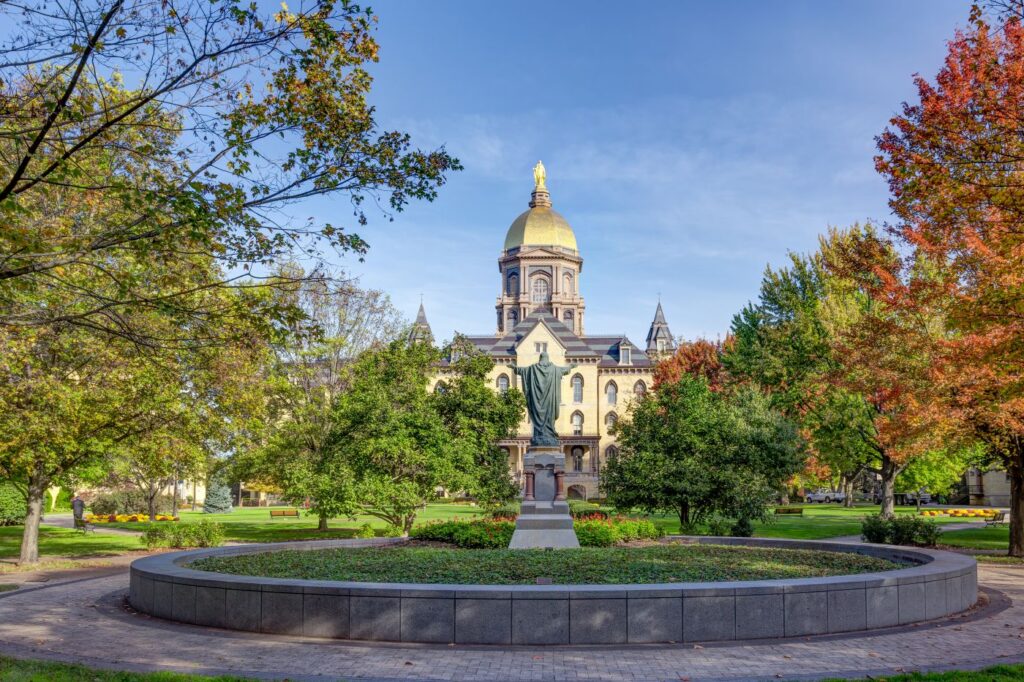
It is one thing, and a deeply good thing, for a Catholic research university to maintain these important principles. It is another thing altogether—even so far as a form of self-betrayal—to elevate and institutionalize someone in the name of academic freedom whose public-facing and widely disseminated views represent both a direct threat to the sanctity of human life and a contradiction of the university’s own “unwavering” commitments and mission. These commitments cannot be affirmed in the abstract while being undermined in the concrete. As Thomas Aquinas might say, such a thing would offend a sense of fittingness or congruence, out of step and out of proportion with the broader animating vision of the whole. Or, as the Gospels or the letters of Saint Paul might say, such a thing is nothing less than a skandalon for Catholic believers. It compromises both the viability and the coherence of the university’s visible, public witness to its own Catholic identity and to the manifestly fruitful figure of Mary, Notre Dame Our Mother, who stands atop the Golden Dome as the “mother of the Life by which everyone lives.”