Patriotism in America is in decline—a decline that has accelerated over the past decade. But it’s not inevitable.
We’ve seen a resurgence of patriotism before. For example, there was an uptick in patriotism after the Vietnam War that is often associated with the Reagan administration. Even those who disagreed with him politically often credited him for this revitalization of belief in America.
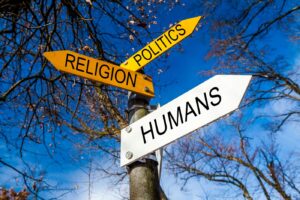
Patriotism is a good thing that ought to transcend the Republican and Democratic parties. It ought to transcend liberalism and conservatism. And I predict that one of the successes of Fidelity Month over the years will be a revitalization of the understanding that patriotism need not be associated with one political party. It is something that ought to be shared across the political spectrum in spite of our differences.
Our decline in patriotism, a love for country, has many origins and symptoms. One of the symptoms—and I would argue one of the origins, too—is that we simply do not teach American history and civics very well. And we cannot love what we don’t know.
Walk into the average civics or history classroom—public or private—and you’re more likely to find political activism than a thoughtful teaching of the American Founding. It’s not that political activism is inherently bad. It’s that the classroom is not the appropriate place for it to happen. Before we decide what kind of political animals we want to be and which philosophies and candidates we want to support, we first must understand the foundational principles of this country, what it means to be American.
Start your day with Public Discourse
Sign up and get our daily essays sent straight to your inbox.Indeed, I would argue as an early American historian that there is no society or nation in the history of mankind for which it is more important for its people to understand its founding principles than the United States. This is not because we’re more important than any other people. It’s because of the nature of our nation’s foundation. But we don’t understand those founding principles well today, and therefore it is very hard for us to resurrect and revitalize this love of country.
I’m also a historian who focuses on institutions, what other social scientists would call the “mediating entities” of civil society. That’s a fancy way to say that they—churches, schools, service clubs, and the like—are where we hash out our differences or at least learn to live with them. To give a sidewalk example: I previously served as president of Wyoming Catholic College in little Lander, a town of 7,000 people (this made it the eleventh largest city in Wyoming). There, as in every place I’ve lived, I was a proud member of the Rotary Club.
People might assume that Lander is politically conservative. In fact, the town splits 50-50 between Republicans and Democrats, because in addition to the conservative college, other institutions are politically left-of-center. One of the only places where we all got along was the Rotary Club. Mediating institutions like that allow Americans of different backgrounds, native tongues, religions, and politics to get together and proclaim their love for country regardless of who is president.
Another place in Lander—and across the country—where politics don’t matter is the Little League baseball field. Our son was on a team with the boys of families who were working for—shall we say—opposite ends of the ballot box. But we became friends. Winning baseball games and forming these young men was more important than our politics, which is just another way of saying that what bound us together was that we were fellow Americans. How we voted and how we went about our lives outside that space didn’t matter.
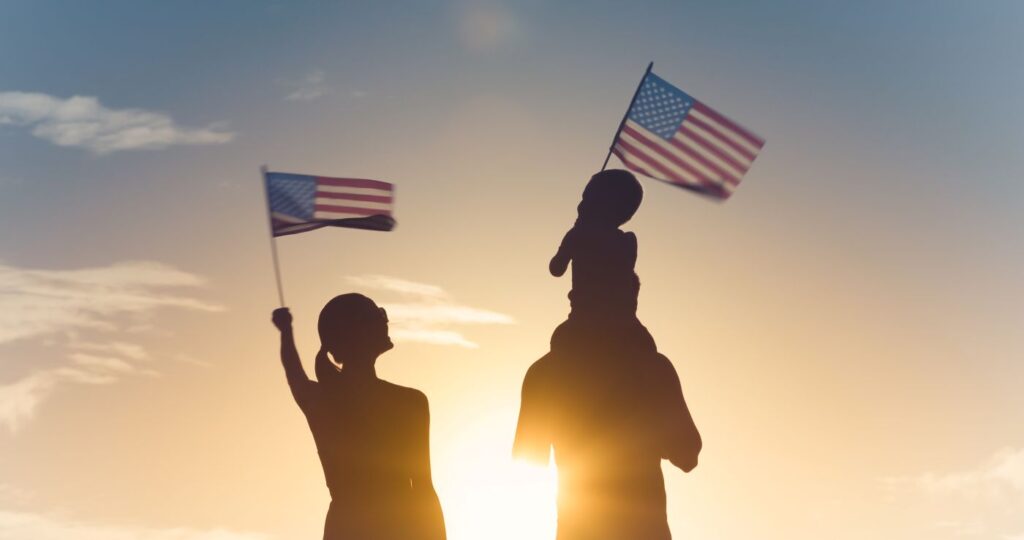
So yes, patriotism can be as simple as flying the flag or even reciting the Declaration of Independence on Fourth of July—something my family and I do every year (a wonderful civic practice that we share with a few remaining left-of-center friends). But perhaps the greatest act of patriotism is something we can do every day: start to initiate or rekindle friendships with people with whom we disagree. Maybe those disagreements are on the things most fundamental to us, but particularly for those of us who are Christians, we know that we are called to love those people anyway.
Social scientists describe this phenomenon in different ways. A couple of times each year, the Pew Research Center and Gallup conduct polls evaluating Americans’ belief and trust in institutions; across the board, it has declined precipitously. Whether it’s the Supreme Court or Congress, newspapers or large corporations, the decline in trust of our shared institutions has been significant.
A revival of patriotism starts in our neighborhoods. And yet, that’s precisely the level we’re most likely to overlook.
Thankfully, the military has proven to be an exception to this trend—at least until the last couple of years. This is good news, because that was not always the case. In the mid-1970s there was a decline in public trust in the military that was largely a result of how multiple presidential administrations prosecuted the Vietnam conflict. That trust was revitalized over decades because Americans began to understand that the process of rebuilding institutions isn’t something that happens on a high level by the board of directors and CEO. It’s something that we do as individuals.
If we want people to believe in newspapers, the military, law enforcement, the Supreme Court, or any other institution, we must go about our own daily lives in a way that’s trustworthy—in a way that’s faithful to God, our families and friends, and country. A revival of patriotism starts in our neighborhoods. And yet, that’s precisely the level we’re most likely to overlook.
Heritage Foundation fellow Russell Kirk gave us a shot in the arm with his wonderful essay “Ten Conservative Principles.” Our interns read it each summer, and many of us reread it frequently. The eighth principle puts into perspective the importance of community for the United States and for us as individual Americans:
Although Americans have been attached strongly to privacy and private rights, they also have been a people conspicuous for a successful spirit of community. . . . In a genuine community, the decisions most directly affecting the lives of citizens are made locally and voluntarily. Some of those functions are carried out by local political bodies, others by private associations. So long as they are kept local and are marked by the general agreement of those affected, they constitute healthy community.
My charge to us is to remember that sometimes we need to turn off the national news. Sometimes we need to ignore national politics—the president of the Heritage Foundation is telling you that—not permanently, but on a routine basis.
Instead, pay attention. To the local news, perhaps, or—even better—to your neighbor. My wife, who is my great accountability partner on practicing what I preach in this regard, reminds me that I need to carve out time in my busy schedule to know our neighbors. She does an excellent job of this, and we have become good friends with our neighbors. We count on them to watch over our home when we’re out of town and vice versa. Our kids are about the same age, and we share (almost) monthly dinners with them.
They are people who disagree with everything that the Heritage Foundation stands for—almost everything with the exception of belief in family and belief in God. I believe that, regardless of our political differences, we ought to be the best of friends. For me, that summarizes how, on a daily basis, we can remember to be lovers of this country by being lovers of our fellow countrymen. And that’s how we begin to restore this country we all love.
Image licensed via Adobe Stock.