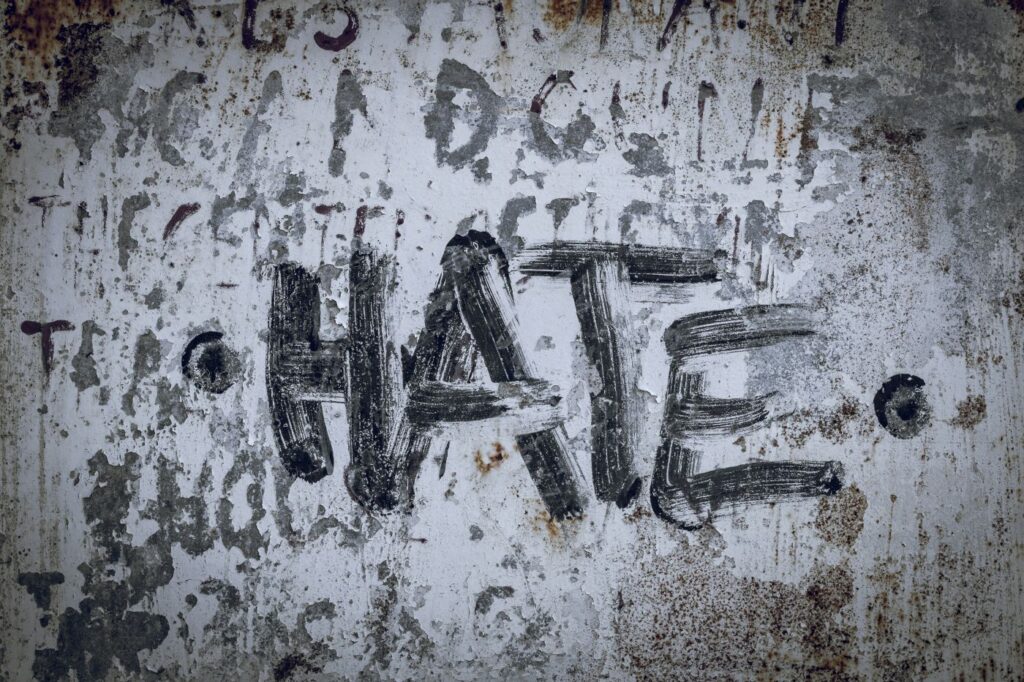
Hate is an energy-intensive emotion. Not for nothing do we speak of burning and devouring hatreds. It is an emotion rarely experienced with tranquility; to fume, to rage, to seethe, all point to the fact that hate is a flame that we stoke. It is a fire that requires sacrifice, usually that of our energy and peace of mind. It is all the more puzzling, then, to consider how often it is that we hate those unknown to us. And even more bewildering is our passionate loathing of abstract categories. Think with what venom many of us hate our political opponents as a collective, be they “libtards” or “deplorables.”
This puzzle came to my attention recently with the rise of anti-Semitism, anti-Israelism, and anti-Zionism in the West. Seeing photos and videos from protests, marches and riots, I could only wonder at the faces of young Americans and Europeans, contorted in their hatred toward me, as I am, admittedly, guilty on all charges: an Israeli, a Jew, and God forbid, a Zionist. Clearly, most of them have never met an Israeli, many have probably never spoken to a Jew, and I would wager that almost none have a clear idea of what Zionism stands for. Yet, there they were, in person and online, all but frothing at the mouth in blind rage against Jews.
Much ink has been spilled on charting the roots and causes of hate and its diverse manifestations, including hatred directed at political opponents, minorities, and among them, Jews. Yet in all these intellectual analyses and sociological investigations, one cause has largely escaped notice: the simple pleasure of hate.
We would all prefer, perhaps, not to acknowledge this truth, that one can savor one’s hatred as one would a piece of rich chocolate. There can be, we must admit, great joy and almost sensual pleasure in allowing ourselves to be consumed by waves of hatred. Think of the last time you gossiped in a particularly malicious manner about a person both you and your interlocutor sincerely despised. Think of the pleasure you felt in removing the guards on your tongue and letting the dark aspects of your psyche run wild. We’ve all been there, even if we’re not proud of it.
This is true to no less degree when our venom is directed at another group. William Hazlitt, the nineteenth-century British essayist, described this human sensation beautifully in an essay that carries an identical title to the one above, “On the Pleasure of Hate.” When we read of past hatreds and prejudices, he writes, “[t]he wild beast resumes its sway within us, we feel like hunting animals, and as the hound starts in his sleep and rushes on the chase in fancy, the heart rouses itself in its native lair, and utters a wild cry of joy, at being restored once more to freedom and lawless, unrestrained impulses.”
Start your day with Public Discourse
Sign up and get our daily essays sent straight to your inbox.But why is hate so pleasurable? What explains its appeal? Perhaps it gives us a sense of freedom, as Hazlitt points out: it releases our aggressiveness and tribalistic tendencies from their cage and gives them room to flash their claws and roar. Perhaps we derive pleasure from knowingly trespassing on social boundaries, from transgressing and asserting our independence from conventions. Perhaps, also, there is a sense of camaraderie involved in hate, as it is a pleasure very often pursued in company.
There is a vital relationship, rarely acknowledged, between hate and righteousness. In many cases, hate takes the form of aggression, anger, and resentment layered with a veneer of righteousness and even virtue. It is truly an ingenious creation of our psyche: warned to steer clear of these negative emotions, like a Trojan horse hate reintroduces them to our thinking and emotional landscape, overlaid with a sense of self-righteousness. One enjoys the pleasure of surrendering to aggression, anger, and resentment, while also feeling in the right. In fact, self-righteousness may be what differentiates hate from anger or rage, which often can be recognized as uncontrolled and unwelcome passions.
However, this doesn’t explain why it is that we direct such hate to those unknown to us. It seems to me that only love equals hate in the passion it involves and the energy it requires. Like hate, love triggers action, mental and physical. But unlike hate, we tend to direct our resources to those closest to us: our family and friends. So, why is it that we passionately love our spouse, our children and our parents, and passionately hate faceless “libtards” or “Trumptards?”
In a sentence, social norms have shifted to proscribe hate and aggression and limit their targets, but human nature has remained unchanged. Over several centuries, the boundaries of polite hatred gradually shrank. First, religious hatred lost its place in polite society. More recently, racial hatred was made unacceptable. In general, aggression, even when nonviolent, has been marked as antisocial, even déclassé. These laudable processes have done much to make our societies more accepting, more peaceful, and more just. They have done nothing, however, to change our human nature: the pleasure we derive from hate, and the need to vent the aggression with which it is entwined.
To better understand and curtail hate in our societies, we should return to looking at hate as a vice, one that tempts us with its promise of freedom and sense of power. The self-prescribed civilizing process limited our array of eligible targets but had little to say about hate itself, perhaps because talk of virtues and morals has largely become obsolete in societies of consumers. Social and political correctness, or performative ethics (i.e., aesthetics: actions and statements judged based on their appearance, rather than their moral content and significance), became supreme, while individual virtue was pushed to the side as at best irrelevant. This focus on appearances and outward propriety, together with the sidelining of personal virtue, has created strange but significant lacunae in our ethical code. In the realm of hate, the perverse outcome is the seemingly ruling tenet: “hate, just make sure to hate the right kind of people.”
The poverty of our moral language, it is important to note, did not minimize our social focus on hate. Quite the opposite: hate crimes and hate speech have become central to our normative order. Think tanks are dedicated to tracking hateful groups and hateful ideologies, and our media lunge at any event that can be linked to hate. We understand the motivating power of hate, its perniciousness, and its possible deadliness. Yet our inclination to avoid talk of moral character, virtue, and the necessity for self-restraint has limited our ability to effectively counter hate and tribal animosity in our societies.
Venting Hate in “Polite Society”
As society narrowed the circle of permissible victims of hate, the faceless and faraway became safe targets for our aggression. Socially, so long as we comply with our clique’s norms and morals, our public image will not be tarnished. And on a more concrete and personal level, it gives us the (wrong) impression that we’re having fun and no one is hurt by it. Hating those closer to us is a messy affair and directing our aggression toward them is doubly so. A feud with a neighbor, for example, can quickly descend into chaos no one wants. But railing against a distant and acceptable target not only will not cost you—it may bring you closer to those who share your inclinations. In this manner, dissociating from our targets not only allows us to be hateful, but has also become a facilitator of aggression.
Hate toward political adversaries is particularly suited to our present cultural moment. They do not belong in any “protected” category, and usually, venomously attacking a political opponent will not ring the alarm of impropriety. Quite the opposite: they are the right kind of people to hate. Hating “them” has become a show of virtue, and the more hateful you are, the more virtuous you appear in your political bubble.
In the basket of polite hatreds, anti-Semitism and anti-Israelism are unique in character. Anti-Semitism is famously a shapeshifting demon and is perhaps the only kind of animosity to maintain its relevance by adapting to contemporary norms. What was religious hatred throughout most of history morphed into racial hostility as this became politically ascendant. Now that racism has become unacceptable, it has changed into political hatred. In other words, Jews are no longer “rats” as they were to the Nazis; they are “settler-colonialists” and supremacist “baby killers.”
One may suggest that anti-Semitism has never really gone away, and that its present outbreak is simply the resurfacing of currents that existed in society but were hidden. Another option is that when Jew-hatred once more became politically palatable, Western culture had much to provide by way of theories, metaphors, and other rhetorical devices and thought-worms. Those awakening to “the Jewish threat” had a limitless array of weapons to draw upon to arm themselves and convince others of its relevance and danger.
Most importantly, hating Jews is cost-efficient: it allows one to experience the pleasure of hate, often without paying the price of social censure Yes, Jews are not entirely exposed, but increasingly, one pays no price for dabbling in good, old-fashioned blood libels. In increasingly tribal societies, Jews are once again alien; a small minority, out of sight for most, and so easily put out of mind. Moreover, in some circles, antisemitism has become a sure path to acceptance and status. It seems that in some segments of the “Woke Right,” antisemitism buys you points as a fearless advocate of hidden truths. On the left, Jew-hatred, at times under the guise of “criticism of Israel” or “anti-Zionism,” has long been not only free but highly beneficial. Paint Jews in Israel as child-killers and grave robbers harvesting Palestinian organs, and Jews in the diaspora as a cabal using their “Benjamins” to bribe politicians, and you paint yourself in tribal colors of so-called humanitarianism and virtue.
And among Jews, Israelis are especially suitable targets for hate. Blatant anti-Semitism still offends sensibilities in many social milieus in the West. Israelis are distant, so they’re not around to remind those who hate them of their humanity. They’re culturally different, being a mixture of East and West, and so much easier to dehumanize even when you do come upon them, with their bluntness and informality. And as targets of hate, they’re all Jews, so one can draw from the deepest well of hate in Western culture in their vilification.
Scapegoating and Shaming
Viewing hate in this manner suggests that it is an unsolvable problem. Western societies have driven religious and racial hatred to the margins, only to replace it with “virtuous” substitutes. Indeed, viewing hatred as a vice suggests that it is not an evil to vanquish but a problem to manage.
The French thinker René Girard posited that societies use sacrificial rites and scapegoating to control human aggression. This allowed societies to maintain their integrity at the price of the offering, be it human or animal. Notably, he asserted that the Jewish and Christian traditions had done away with this sacrificial mechanism, by vindicating the scapegoat and breaking the illusory justification of its victimization.
In a famous passage, William James gave voice to this rejection of scapegoating. He writes that were we to be offered a utopian world “on the one simple condition that a certain lost soul on the far-off edge of things should lead a life of lonely torture,” we would immediately reject it: “[A] special and independent sort of emotion . . . would make us immediately feel, even though an impulse arose within us to clutch at the happiness offered, how hideous a thing would be its enjoyment.”
I cannot help but be less optimistic than James. Perhaps because we have steered away from our moral traditions, it is not entirely clear to me that one would “immediately feel” such horror in response to a mob sacrifice of political opponents, and now once again, Jews. In a way, are sacrifices such as these not already commonplace? Are not cancelings, shamings, and boycotting forms of offerings to satiate mob hate?
On an individual and social level, we must recognize the allure of hate. There is a need, of course, for analyzing and addressing hate intellectually, but we should not forget its more visceral charms. Vices such as these do not disappear through intellectual warfare alone, as we all know from combatting other negative inclinations.
Approaching hate as a vice means that we fight it as a failure of character and reintroduce a discourse of virtue and morality to the public sphere. It means also that we acknowledge hate’s seductive nature; hatred is condemnable, but being hateful is a moral pitfall that has ensnared us all.
Approaching hate as a vice means that we fight it as a failure of character and reintroduce a discourse of virtue and morality to the public sphere.
When it comes to drinking, eating, and other possible vices, we draw a line when our actions begin to hurt ourselves and others. With hate, especially when targeting those unknown to us, drawing this line may prove impossible. And so, self-awareness that no hate is without cost, and self-restraint that is required with all ineradicable vices, are both central.
Otherwise, when our faceless targets do take form, it may be too late. In the end, hate directed at the faceless often finds a face. This is exactly what happened in the recent, tragic murder of Yaron Lischinsky and Sarah Milgrim, a beautiful young couple murdered by a rabid gunman, riding a wave of blind “innocent” hatred against Jews and Israel.
Nor is present hateful rhetoric unique in its lethal outcome. In 2014, protests against police brutality devolved into collective expressions of hatred toward policemen. As protesters have recently called to “globalize the intifada,” demonstrators then chanted for “dead cops.” Then, as now, it did not take long for their abstract hate to find its flesh-and-blood targets: two NYPD officers, Rafael Ramos and Wenjian Liu, were murdered by an enraged shooter while sitting in their patrol car.
Alarmingly, even such murderous violence does little to mitigate the outpouring of hate in our societies. Instead of causing anti-Israel activists to rethink their stances and rhetoric, many chose to double down and glorify the gunman. Needless to say, hostility toward policemen hasn’t subsided over the past decade.
It has become our tendency to fight hate with ideas. We have intellectualized it: analyzed its sources—poverty, ignorance, social seclusion—and rationalized its manifestations (“our political adversaries really do deserve our vitriol”). We’ve turned our modern psychologistic and scientific eye on the issue to reach comprehensive understanding. Yet hate has failed to disappear. Despite our awareness, our think tanks, our study groups, our committees and NGOs, hate actually appears to be on the rise.
I am not writing here to propose a solution. Hate cannot be eradicated, and it is not clear to me that it should. All human passions have their place when morally constrained. But without moral restraints, and when self-indulgence is celebrated as a virtue, it isn’t surprising that pleasurable hate creates hateful masses whose frenzy culminates in murder.
The Jewish sage Hillel the Elder famously said, “In a place where there are no men, strive to be a man.” Here too, it seems, this adage captures an essential and relevant truth. In company and alone, when hate beckons, threatening to engulf us and subsume our individuality, we should strive to be men or women. Standing as individuals in its current, aware of its seductive nature, we just may be able to keep our heads above its all-consuming waves.
Image licensed via Adobe Stock.