













by on January 30th, 2012

The “marriage equality movement”: that’s the name chosen for themselves by same-sex “marriage” supporters. The implicit argument is that the state’s granting marriage licenses only to opposite-sex couples is undue discrimination. The claim has an initial plausibility: the state grants a marriage license to John and Mary but not to Jim and Steve. Isn’t that unequal treatment? But this charge, I will show, rests on a profound confusion about both...

by on December 18th, 2012

“The President’s Marriage Agenda for the Forgotten Sixty Percent,” despite the impression its title might give, was released Sunday not by the Obama administration but by the Institute for American Values and the National Marriage Project at the University of Virginia. It is a timely, compelling, and important report, but it falls short in a basic way: it never once even attempts to say what marriage is. But you cannot advance a marriage agenda...

by on October 31st, 2008

Californians have already put to rest one of the biggest myths about gay marriage in American politics today: namely, that regular people don't really care about the issue. Believe me, they do. The Yes on 8 campaign to overturn the California supreme court decision imposing gay marriage is generating an unprecedented amount of activism, attention, and involvement. My friend and colleague Brian Brown just sent me an email with the subject "Califo...

by on June 25th, 2012

“We’ve been fighting about gay marriage for what, 15-20 years now. Is there any evidence that fighting gay marriage is contributing to a greater appreciation among the broad society of the marital institution? Is there any evidence that the re-institutionalization of marriage is happening as a result of opposing gay marriage? And the best answer I can give to that is 'no.'” – David Blankenhorn. With that quote Mark Oppenheimer, the Beliefs colum...

by on August 23rd, 2011

The mainstream media have labeled marriage the “hottest front in the culture war.” Much to the media’s surprise, several of the GOP candidates have already signed the National Organization of Marriage’s (NOM) Marriage Pledge. They were surprised by major candidates’ willingness to sign NOM’s pledge because this was supposed to be the year the social issues did not matter. Presidential candidates for the 2012 election need to know that marriage i...

by on November 5th, 2012

Would recognizing same-sex relationships as marriages be much of a game-changer? What impact, if any, would it have on the public conception of marriage or the state of a nation’s marriage culture? There has been no shortage of speculation on these questions. But the limited American experience with same-sex marriage to date gives us few concrete answers. So it makes sense to consider the Canadian experience since the first Canadian court establ...

by on November 27th, 2012

Discourse about marriage is often short on reason and compassion. Arguments and objections can be mercilessly logical, forgetful of persons behind the positions; at other times reason seems to have taken a holiday, replaced with a kind of shrill indignation. Perhaps failure is inevitable when marriage means too many things. Interlocutors cannot avoid speaking at cross-purposes when terms are in flux, and positions cannot but appear arbitrary if...

by on April 24th, 2009

The Iowa Supreme Court recently proved that the critics of same-sex “marriage” are correct: we are not being urged to make marriage more inclusive, but to radically redefine the nature of marriage itself. With its decision, the Iowa Supreme Court covertly but profoundly changed the meaning of marriage. The Court abolished the essential public purpose of marriage, and replaced it with a new understanding of marriage that is neither essential nor...

by , and on March 30th, 2011

In Part One of this article, we argued that marriage is a union of a man and a woman, committed to sharing their lives together on the bodily, emotional, and rational-volitional levels of their being, in the kind of community that would be naturally fulfilled by having and rearing children together.  Since that kind of multi-leveled community cannot be formed by two persons of the same sex—such persons cannot unite biologically in the way that h...

by on December 15th, 2011

Earlier this year, I was part of a Constitution Day panel discussion on same-sex marriage at Rutgers University. With seven panelists in a 90-minute program (four in favor of same-sex marriage and three opposed), we were each given just a few minutes for opening statements. I decided to make ten short observations, each of which could prompt more discussion afterward. Below are eight of those observations. (I omit two of them that were narrowly...

by on July 26th, 2011

Earlier this summer, my fellow philosophy graduate student at Princeton University, Richard Chappell, criticized an article in which Robert P. George, Ryan T. Anderson, and I defend the conjugal view of marriage as the union of husband and wife. I’m grateful for his criticisms, which allow me to correct some misinterpretations and respond to unsuccessful objections. But like Chappell’s, my contribution to this debate begins with a comment about ...

by on February 15th, 2013

Everyone has blind spots. It is philosophy’s ambition to cure these by canceling them out, through dialogue and scrutiny of assumptions. But even academic philosophy has its dogmas. One current example is support for same-sex marriage: To question it is to be anathematized by those occupationally averse to anathemas. So I was both pleased that Alex Worsnip reviewed my co-authored book What Is Marriage? Man and Woman: A Defense, and unsurprised t...

by on December 22nd, 2009

Marriage is a wonderful institution,” deadpanned Groucho Marx, “but who wants to live in an institution?”According to W. Bradford Wilcox, the answer is “not too many Americans.” In an important essay in National Affairs’ inaugural issue, Wilcox shows how Americans in the last four decades have abandoned the institutional model of marriage, which emphasized the welfare of children, in favor of the soul-mate model of marriage, which prioritizes t...

by on July 30th, 2012

Why do the advocates of same-sex marriage want what they want? And why do defenders of traditional marriage, as uniting men with women to form families, resist such a change? One cannot do better for achieving clarity on such questions than by reading Debating Same-Sex Marriage, co-authored by John Corvino and Maggie Gallagher. Corvino, who teaches philosophy at Wayne State University in Michigan, and Gallagher, a co-founder of the National Orga...

by , and on March 28th, 2011

Activists seeking to redefine marriage typically claim that it is unfair—even arbitrary—for law and public policy to continue to honor the historic understanding of marriage as the conjugal union of husband and wife. Believing that marriage has a degree of malleability that our legal tradition has heretofore failed to recognize, they maintain that “excluding” same-sex partners from marriage violates a moral right possessed by every individual to...

by , and on January 3rd, 2011

In his latest reply to our argument in the Harvard Journal of Law and Public Policy that marriage is the conjugal union of husband and wife, Kenji Yoshino presents a truncated and distorted version of our view. Nevertheless, his answers to our challenges to him and others who demand the redefinition of civil marriage force Yoshino into awkward moral and political positions—including one that seems directly at odds with a stance he has prominentl...

by on October 3rd, 2012

Elizabeth Brake’s Minimizing Marriage breaks new ground in the contemporary liberal critique of traditional arrangements. The object of her critique is what she calls amatonormativity—the belief that society should value two-person, amorous love relationships. Even same-sex marriage (SSM) advocates are too restrictive for Brake in that they would confer benefits on two people alone; SSM advocates are unwitting amatonormativists. Their defenses o...

by on May 2nd, 2011

People generally take it for granted that marriage will be “available,” but despite the powerful forces inclining people to marry, the availability of marriage as an institution they can choose to enter cannot be taken for granted. This is not unlike another major social institution: property. There are powerful forces inclining human beings to accumulate property, and there is a strong natural basis for properly qualified property rights, but i...

by on March 13th, 2012

The New York Times’ recent story that more than half of births to American women under age 30 now occur outside of marriage, and the conversation spurred by Charles Murray’s new book, Coming Apart: The State of White America, 1960 – 2010, have shifted public gaze to a population largely ignored in the scholarly literature of the past few decades: the 58 percent of Americans with a high school diploma but no college degree—what some might call “...

by , and on December 29th, 2010

We are grateful for Andrew Koppelman’s recent reply to our argument in the Harvard Journal of Law and Public Policy that marriage is the conjugal union of husband and wife. Thanks to his honesty and candor, the ensuing exchange should set in stark relief the implications of redefining civil marriage. Professor Koppelman graciously credits our article with having “done [readers] a service with [a] succinct and clear exposition” of the arguments f...

by on April 2nd, 2012

As a libertarian myself, I have been quite disappointed that the “default” libertarian position on marriage has become little more than a sound-bite: “Let’s get the state out of the marriage business.” With all due respect, this position is unsound. I will not be able to respond to this sound-bite with another sound-bite. The issues surrounding marriage are too deep. But I am not deterred from trying to persuade thoughtful readers who are up to...

by on September 19th, 2012

In the now-famous interview with NBC’s “Meet the Press” that precipitated President Obama’s public endorsement of same-sex marriage, Vice President Joe Biden asserted that “all marriages, at their root, are about” the following question: “Who do you love?” As contentious as the recent marriage debates often have been, both the advocates and the opponents of same-sex marriage might agree with the basic point of Biden’s assessment in affirming tha...

by on July 3rd, 2009

PD: What is the struggle over the legal recognition of same-sex unions a struggle about? Is it about legal benefits? Or is it about something else? George: It’s about sex. Those seeking to redefine marriage began by insisting that what they were fundamentally interested in was gaining needed benefits for same-sex domestic partners. Legal recognition of same-sex partnerships was necessary, they said, so that partners could visit each other in...

by on April 25th, 2013

In November 2008, after a contentious political battle, the voters of California approved an amendment to their state constitution restoring their historic definition of marriage. “Only marriage between a man and a woman is valid and recognized in California,” read Proposition 8, California’s Marriage Protection Act. A populist response to a California supreme court decision redefining marriage to include same-sex relationships, Prop 8 merely co...

by on December 6th, 2011

Why is there a gulf between those who see same-sex marriage as an impossible legal and cultural revolution, a bridge too far, and those who see it as the logical next step on a path well-trodden in family law? In part, it is the difference in perspective between those familiar with classical expressions of the goods and goals of marriage found in over a century of Supreme Court decisions, and those with their eyes fixed upon more recent legal de...

by on December 19th, 2008

In the December 15th edition of Newsweek, both Jon Meacham in his editor’s note and religion editor Lisa Miller in her front-page article mock arguments from scripture. At the same time, they invoke that same Bible’s authority for a “more general” message of “inclusivity,” in order to lobby for making gay marriage a sacrament. Meacham and Miller paint all opposition to the radical re-definition of marriage as hateful bigotry, comparing it to ra...

by on July 27th, 2011

As debates currently rage about budget deficits, debt ceilings, and jobs, I am pleased that the Senate is discussing what are arguably the two most important jobs in our society—the jobs of mothers and fathers. The Defense of Marriage Act (DOMA) gives us a chance to think about the roles of mothers and fathers in our society, and also to consider a question often overlooked in these debates: why is government in the marriage business? Congress e...

by on March 21st, 2011

It is important to situate the same-sex marriage issue in the context of dramatic changes in our society over the last forty years that bear upon the very nature of marriage. These changes have paved the way for the even more dramatic changes implicit in the adoption of homosexual marriage. We should not hope to return to some mythical golden age of marriage in the past.  Marriage has always had its problems, many of them significant. There have...

by on November 15th, 2012

Last month, NYU School of Law hosted a symposium titled “Making Constitutional Change: The Past, Present, and Future Role of Perry v. Brown.” Originally designated Perry v. Schwarzenegger, this is the case in which district judge Vaughn Walker declared California’s Proposition 8 unconstitutional, a decision later affirmed by the Ninth Circuit. It is also the case that proponents of legally redefining marriage hope will secure same-sex couples a...

by , and on December 17th, 2010

Last week we released our Harvard Journal of Law and Public Policy article, “What is Marriage?” It offers a robust defense of the conjugal view of marriage as the union of husband and wife, and issues specific intellectual challenges to those who propose to redefine civil marriage to accommodate same-sex partnerships. Kenji Yoshino of NYU Law School, a prominent and influential gay rights legal scholar, has posted on Slate a response to our arti...

by on April 2nd, 2013

In a column at CNN.com, Marc Stern asks whether “gay rights” will infringe religious liberty. By “gay rights” he means eradication of sexual complementarity from marriage laws. His answer is yes, sometimes: “In some instances the rights of same-sex couples will unavoidably trump religious liberty rights.” Why? If the Supreme Court redefines marriage by judicial fiat, religious observers will be forced to choose between obedience to conscience an...

by on January 4th, 2013

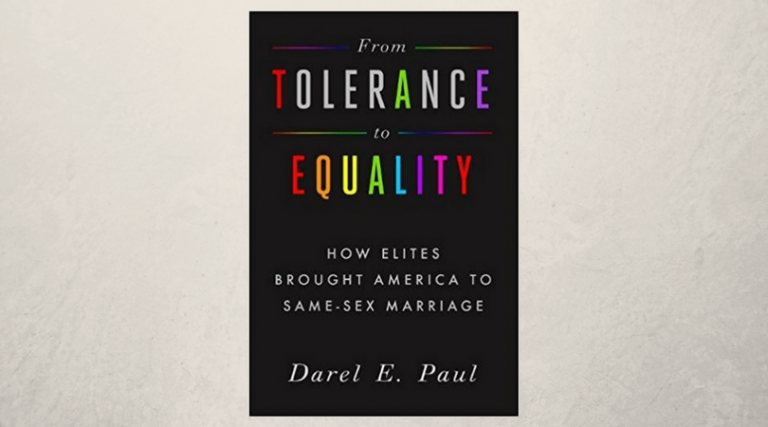
It is remarkable that the idea of same-sex marriage has gained ground so rapidly. Those most quick to accept the idea have been elite liberals, with ordinary Americans lagging behind but becoming more accepting of the idea. In the thick of the struggle over the law and politics of marriage, we can easily forget how novel is the idea of two men or two women marrying each other. This fact came home to me when I participated in a forum on the subje...

by on June 19th, 2009

The question of whether or not there should be same-sex “marriage” has stirred passions and launched debate across the nation. But this debate raises a larger question: why is there an institution called “marriage” at all in a secular society? That is, why should a secular state recognize and structure, even encourage, human associations that have traditionally been called “marriages”? Furthermore, if a secular state does institute marriage, how...

by on June 21st, 2012

Illinois is now “ground zero” in the ongoing battle to preserve traditional marriage. On May 30, 2012, the American Civil Liberties Union and Lambda Legal Defense and Education Fund, Inc., filed separate lawsuits in the Cook County Circuit Court (which includes the City of Chicago) on behalf of a number of same-sex couples challenging the Illinois law that reserves marriage to opposite-sex couples (Illinois does, however, already recognize same...

by on March 10th, 2009

One proposed solution to the divisiveness of the same-sex marriage debate is to have the government get out of the marriage business altogether. This proposal is appealing because it seems to remove marriage from the realm of political contentiousness. We could mimic a market-type solution, in which individuals can make their own decisions about the meaning of marriage, and we need not make any collective decision. But these appearances are dece...

by on January 10th, 2012

For a number of years, there has been a contentious public debate in the United States on homosexuality and, more recently, same-sex marriage. Like any other social issue, Americans hold diverse opinions on these two issues. However, a not-so-subtle part of the recent public discourse has been treating these different topics—homosexuality and same sex-marriage—in tandem, rather than separately. This line of reasoning suggests that opposition to...

by on July 19th, 2012

It was only yesterday, was it not, that we were being assured that the redefinition of marriage to include same-sex partnerships would have no impact on persons and institutions that hold to the traditional view of marriage as a conjugal union? Such persons and institutions would simply be untouched by the change. It won’t affect your marriage or your life, we were told, if the law recognizes Henry and Herman or Sally and Sheila as “married.” Th...

by on March 5th, 2012

The cultural institution of conjugal monogamy, understood as the committed union of one man and one woman, has long performed a valuable task for civil society. It connects parenting to procreation, securing both normative and practical links between children and their parents—fathers in particular. Until recently, the legal institution of marriage—the institution created by law that we call “marriage”—has always mapped directly over the cultura...

by on May 21st, 2010

While doing research for an academic paper on the topic of same-sex marriage and political liberalism, I was struck by how many authors, including judges, draw an analogy between bans on interracial marriage and the present law in almost every state in the United States that recognizes marriage as a union between one man and one woman. The court cases most frequently cited by these writers are Loving v. Virginia (1967), the U. S. Supreme Court c...

by on July 31st, 2009

Proponents of traditional sexual morality can take some comfort in the fact that, a few cynics and radical secularists aside, there is widespread agreement about the moral wrong of sexual infidelity in marriage. Although the norm requiring sexual exclusivity within marriage can sometimes seem as if it is honored more in the breach than the observance, the response to recent cases of adultery among public figures is not limited to accusations of...

by on May 10th, 2012

Yesterday President Barack Obama, in an interview with ABC News, came out in support of same-sex marriage. This completed an “evolution” long in the making. The president, who was openly in favor of same-sex marriage in 1996, when he was running in a liberal state legislative district in Illinois, has been tap-dancing on the issue since 2004, when he stepped up to a statewide constituency in his run for the U.S. Senate. In the 2008 presidential...

by on April 4th, 2013

Opponents of same-sex marriage resist it because it amounts to redefining marriage, but also because it will invite future redefinitions. If we embrace same-sex marriage, they argue, society will have surrendered any reasonable grounds on which to continue forbidding polygamy, for example. In truth, proponents of same-sex marriage have never offered a very good response to this concern. This problem was highlighted at the Supreme Court last week...

by on February 11th, 2013

The briefs filed in Hollingsworth v. Perry, the Supreme Court case on California's Proposition 8, reveal something odd. Much of the debate over same-sex marriage has been a fight over metaphors. Can a same-sex couple mean the same thing as a man and a woman, even if the body parts are not identical? Can domestic partnerships mean “separate but equal” and embody a new Plessy v. Ferguson? Is Proposition 8 analogous to “separate but equal”? Is gay...

by on February 24th, 2012

A few years ago, MTV ran a short cartoon segment that began with two men and two women dressed in traditional wedding attire. As a bridal chorus played on a pipe organ in the background, the two brides and the two grooms reached out to hold hands with each other. “Watch and Learn,” the 15-second spot advised. The commercial was, in many ways, just a sign of the times. Massachusetts had begun granting marriage licenses to same-sex couples the pre...

by on February 9th, 2012

Perhaps there’s something in the water in California. In the Golden State, the judges seem to be in the grip of logical fallacies. First there was Judge Vaughn Walker of the U.S. District Court in San Francisco, who argued eighteen months ago in Perry v. Schwarzenegger that a right of same-sex marriage was to be found in the capacious folds of the due process clause of the Fourteenth Amendment. A crucial element in Judge Walker’s reasoning (as I...

by on April 8th, 2013

Michelle was 22 when she found herself pregnant. She was in a committed relationship with all signs pointing to marriage, she says, but since she had just completed college, with ambitious career plans for her future, children weren’t on the horizon yet. “Although I did want a baby with my now-husband (even at the young age of 22), I was devastated because I felt like my life was ruined,” she writes in a blog post. “Everything I wanted to accomp...

by on March 15th, 2013

...rom market trades. When economists successfully uncovered the regularities of market behavior, they began taking their market analysis to other domains of human activity, such as politics and government, religion, and even to marriage and the family. In these settings, the realities of buying and selling at actual prices in actual markets gave way to analysis of as-if exchanges at “shadow prices” in metaphorical markets. Theodore Schultz, Gary Be...

by on May 14th, 2012

The president has recently received a good deal of credit from liberal commentators for having come out clearly in support of same-sex marriage. Having once opposed it, and having more recently said that his position was evolving, he has now said that he is in favor of it. The credit he is getting for this supposedly brave stand is undeserved, however, because the president’s position is still, on a close examination, very muddled. It is suffici...

by on April 15th, 2013

As the national marriage debate advances, history can teach us a lesson about our circumstances. Consider alcohol prohibition. In his excellent book, Last Call: The Rise and Fall of Prohibition, Daniel Okrent charts the rise of the movement that led to the Eighteenth Amendment and its later repeal. Prohibitionism began a century before the law changed, born of real concerns about the tragedies alcoholism inflicted on countless American families....

by on November 26th, 2012

Election Day was a drubbing for marriage. The ballot initiatives to protect marriage lost by over 4% in Maine, Minnesota, Washington State, and Maryland. Those who support same-sex “marriage” reportedly spent over $33 million, while those who defend marriage spent just over $10 million. Many friends have said that same-sex marriage is inevitable. It is not. I have confidence that fence-sitters will enter the fray in support of traditional marria...